
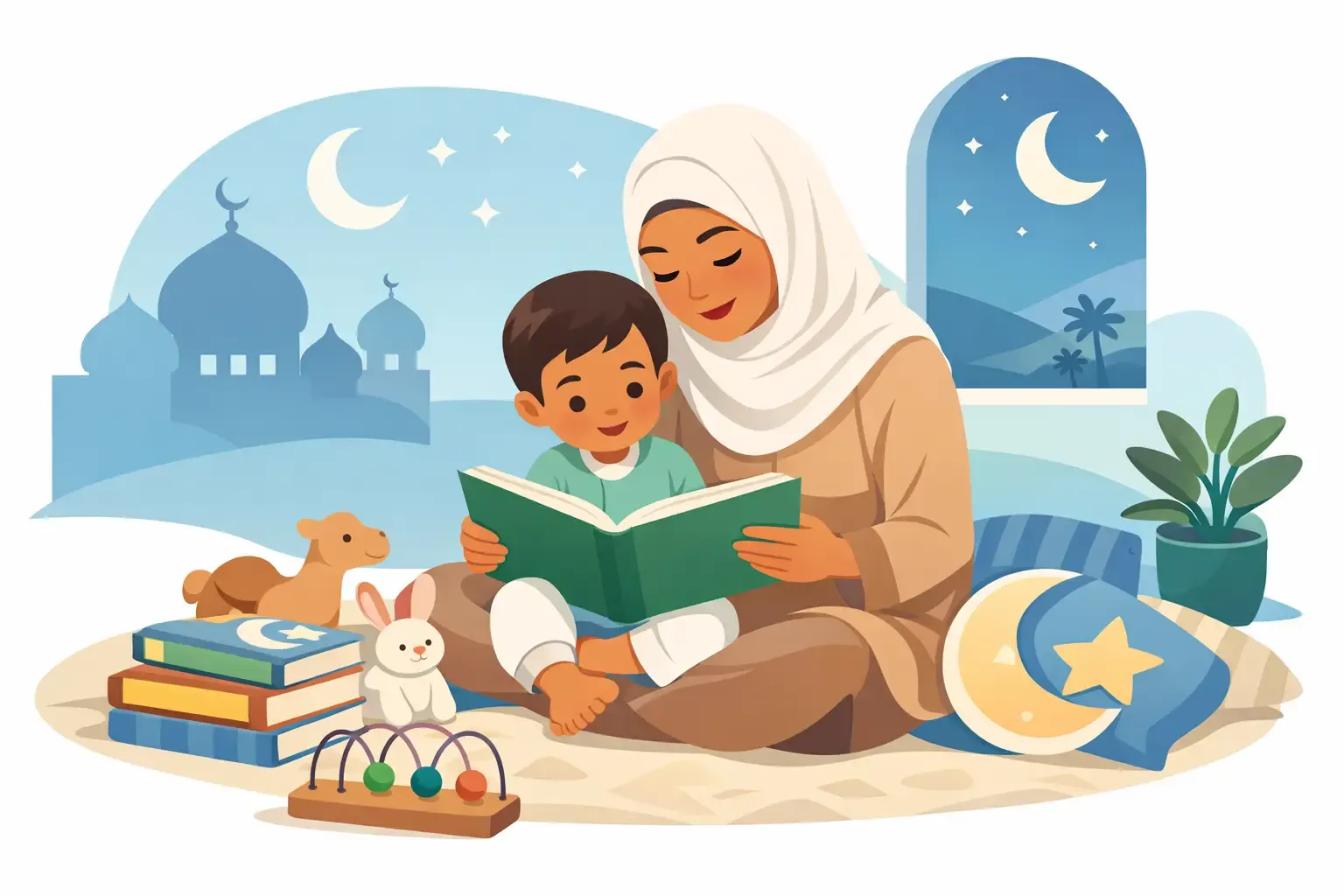
10 Top Books for Muslim Toddlers to Read Together
For children ages 1 to 3, the best choices are usually not the books with the longest lessons. They are the ones with sturdy pages, warm illustrations, repeatable words, and ideas a child can connect to real life: saying Bismillah before eating, thanking Allah for rain, visiting the masjid, or sharing with a sibling. A meaningful home library does not need to be large. A few well-chosen books, read often and with affection, can become part of a child’s earliest Islamic foundation.
What makes a toddler book worth choosing?
Toddlers learn through repetition, movement, sound, and relationships. A book may be beautifully written, but if the language is too dense or the pages require a long attention span, it may be better saved for preschool. For this age, look for board books or durable picture books with clear illustrations and one main idea per page.
Representation matters, too. Children benefit from seeing Muslim families, diverse skin tones, modest dress, mosques, Arabic words, and celebrations shown with warmth and normalcy. At the same time, a balanced shelf should not make faith feel limited to special occasions. Books about kindness, animals, feelings, family, and the natural world can all support Islamic values when parents read with intention.
The following selections include books that work especially well for toddlers, along with a few picture books that may be better enjoyed in short sections. Ages and editions can vary, so use your child’s attention span as the guide.
10 top books for Muslim toddlers
1. I Say Bismillah by Noor H. Dee
This gentle board book centers on a phrase many Muslim families want their children to use naturally. Its simple rhythm invites little ones to say Bismillah before everyday activities, helping faith become part of a familiar routine rather than a formal lesson.
Read it before meals, getting dressed, or leaving the house. The key is not asking a toddler to memorize every page. Pause, smile, and repeat the phrase together in the moments where it belongs.
2. Allah Made Everything
Books about Allah’s creation are especially suitable for young children because toddlers already notice birds, leaves, clouds, pets, and puddles. A creation-themed book gives parents a natural way to connect that curiosity to gratitude and awe.
Choose an edition with bright, uncluttered artwork and short text. After reading, carry the conversation outdoors: Allah made the warm sun, the tiny ant, and the soft grass beneath our feet. This helps a child connect the page with the world around them.
3. Baby’s First Quran Stories by Saniyasnain Khan
A toddler does not need every detail of a Quranic story. They need the loving, memorable core: Prophet Nuh and the animals, Prophet Yunus and the whale, or Prophet Musa’s courage. Baby’s First Quran Stories introduces these stories in a visual, accessible format that can grow with a child.
For younger toddlers, choose one page or one scene rather than reading the entire story in one sitting. Revisit it often. Familiarity is what turns a story into a meaningful part of a child’s memory.
4. Goodnight Stories from the Quran by Saniyasnain Khan
This collection is often better for older toddlers and preschoolers, but it can still earn a place in a toddler library when used thoughtfully. The stories have more words than a board book, so parents may want to simplify as they read.
A bedtime approach works well: select one illustration, name the Prophet, and share one takeaway such as Allah helps us, we tell the truth, or we are kind to animals. The goal is a peaceful connection, not finishing a chapter.
5. My First Book About Ramadan by Sara Khan
Ramadan can feel magical to a toddler, even before they understand fasting. The moon, family meals, lanterns, prayer, giving, and anticipation all offer rich sensory experiences. This book introduces the month in language children can understand.
Use it before Ramadan begins, then return to it throughout the month. Let your child point to what looks familiar in your home. When they see a prayer mat, dates, or a crescent moon in the book, they begin to understand that Ramadan is a family experience they belong to.
6. My First Book About Hajj by Sara Khan
Hajj is a big idea, but toddlers can understand the basics of people traveling, wearing simple white clothes, praying together, and asking Allah for forgiveness. A first book about Hajj can introduce the beauty of Muslim unity without overwhelming a young listener.
Keep the explanation concrete. You might say that Muslims from many places go to Makkah to worship Allah together. If your child has family members who have performed Hajj or Umrah, showing a family photo alongside the book can make the learning more personal.
7. Golden Domes and Silver Lanterns by Hena Khan
This colorful picture book introduces colors through objects and experiences found in Muslim life. It is particularly helpful for toddlers who are already naming colors and pointing to favorite objects.
Some children will enjoy the full text, while others may simply study the artwork. Both are valuable. Ask easy questions such as, Can you find something blue? or Where is the moon? This supports early vocabulary while reinforcing a joyful sense of identity.
8. Under the Ramadan Moon by Sylvia Whitman
The soft, lyrical style of this book makes it a lovely choice for family reading during Ramadan. It captures the atmosphere of the month through shared meals, prayer, nighttime skies, and anticipation.
Because the language is more poetic than a typical toddler board book, it works best when read slowly. You do not need to explain every line. Let the illustrations lead, and allow your child to absorb the feeling of the season.
9. The Best Eid Ever by Asma Mobin-Uddin
Eid stories help young children understand that joy, generosity, and care for others belong together. This title offers a warm message about sharing and community, making it especially meaningful around Eid al-Fitr.
For toddlers, focus on the parts they recognize: new clothes, family, food, gifts, and helping someone else feel included. Afterward, invite a small act of kindness, such as choosing a treat to share or making a card for a loved one.
10. An Islamic alphabet book
An alphabet book with Arabic letters, Islamic vocabulary, or familiar words such as Allah, masjid, dua, and zakah can be a useful everyday resource. The strongest versions do not overload children with definitions. Instead, they offer clear pictures and a playful invitation to notice sounds and letters.
Keep expectations light. At age 1 to 3, the goal is exposure and enjoyment, not formal Arabic instruction. Sing the letters, trace them in the air, and celebrate your child’s curiosity. Early positive associations can make later learning feel welcoming rather than pressured.
How to turn reading into a faith-building routine
The value of these books comes alive in the way they are shared. A consistent five-minute reading ritual is often more effective than an occasional long session. Try keeping two or three books in a low basket where your toddler can choose one, then rotate titles every few weeks to keep familiar stories fresh.
Make reading interactive. Let your child turn pages, point to a moon, copy an animal sound, or say a repeated phrase. If they wander away halfway through, that is normal. Toddlers learn even when they listen while moving, and forcing them to sit still can make books feel like a task.
It also helps to connect each story to action. After a book about gratitude, say Alhamdulillah for a snack. After a book about giving, help place food in a donation bag. After a book about the masjid, practice taking off shoes neatly at home. These small connections show children that Islamic values are lived with gentleness every day.
A well-loved toddler book may end up with bent corners, sticky pages, and favorite lines repeated hundreds of times. That is not a sign that it has been outgrown. It is evidence that your child is building a language of faith, belonging, and love - one shared story at a time.