
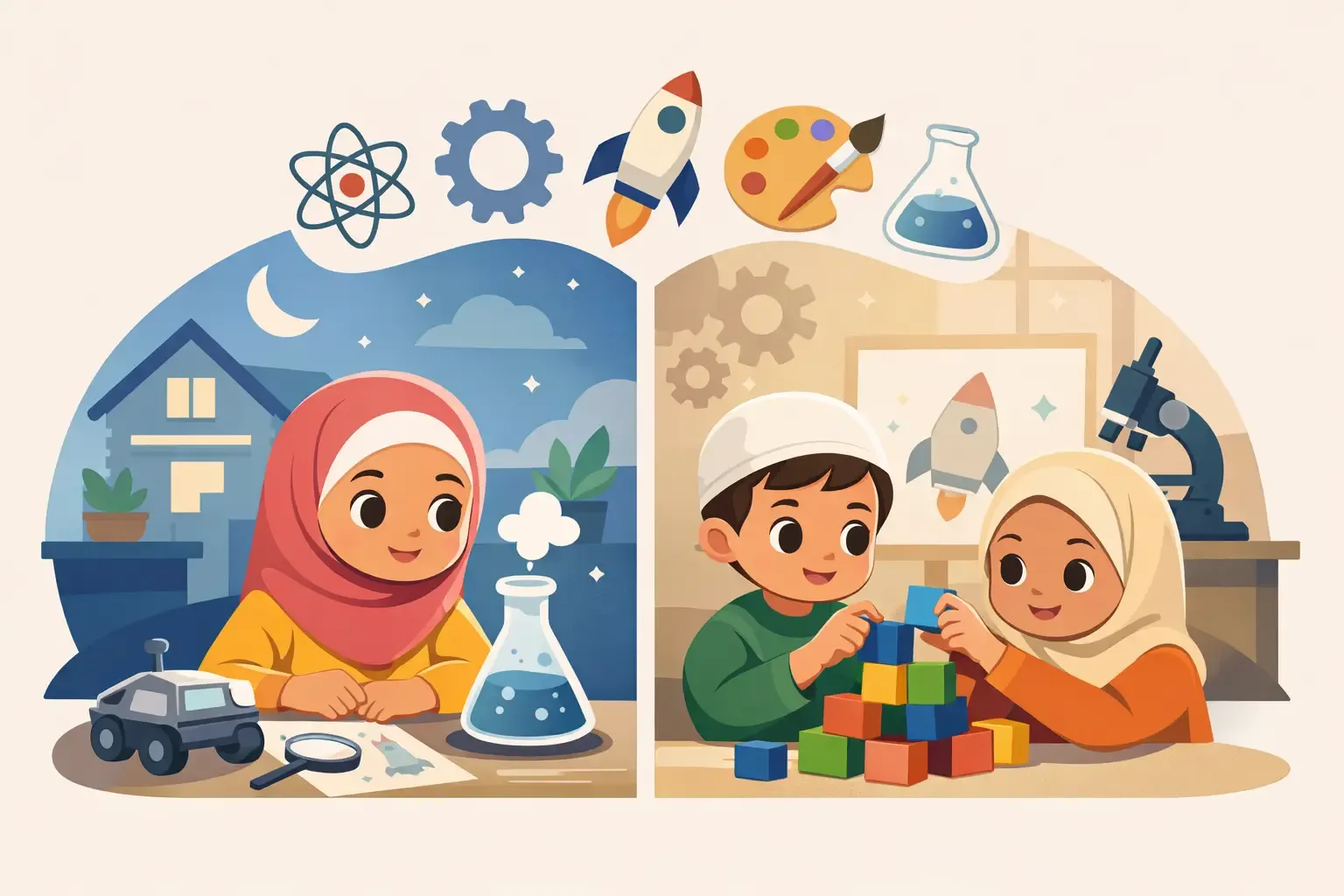
STEAM for Muslim Preschoolers at Home and School
For young children, STEAM is not a subject that requires complicated equipment, screens, or advanced vocabulary. It is a way of learning through play, observation, building, trying again, and talking about what happens. When it is grounded in Islamic values, it also becomes an opportunity to practice gratitude, patience, responsibility, and respect for Allah's creation.
What STEAM Means in the Preschool Years
STEAM stands for science, technology, engineering, arts, and mathematics. In a preschool setting, these areas often overlap naturally. A child mixing colors is exploring science and art. A child creating a shelter for toy animals with blocks is experimenting with engineering, problem-solving, and measurement. A child sorting leaves by size is building early math skills.
The goal is not to make four-year-olds memorize scientific facts or use technology before they are ready. The goal is to nurture habits that support lifelong learning: curiosity, careful observation, creativity, communication, and the confidence to keep trying after a first attempt does not work.
A strong early STEAM experience is hands-on and age-appropriate. Children learn best when they can touch, move, test, repeat, and explain their thinking in simple words. Adults provide safety, materials, and gentle questions, but children should have room to make discoveries of their own.
STEAM for Muslim Preschoolers Begins With Wonder
Islam encourages us to reflect on creation. The changing sky, the growth of plants, the rhythm of rain, and the variety of animals can all become meaningful starting points for learning. This does not mean turning every activity into a lesson with a single religious answer. Rather, it means helping children connect wonder with thankfulness and care.
When a child watches a bean sprout grow, an educator might say, “Allah creates living things with such care. What do you notice about the roots today?” The child is invited to observe closely while also developing an awareness that creation is meaningful.
This approach protects the joy of discovery. A child does not need to be corrected for every unfinished explanation. If she says the plant is “drinking” water, the adult can affirm her observation and add gentle language: “Yes, the plant takes in water through its roots. Let’s see what happens if it has sunlight, too.”
Faith-centered STEAM should feel warm and natural, not forced. Its strongest lessons are often found in everyday moments: caring for a class plant, using water thoughtfully during an experiment, or working kindly with a friend when a tower falls down.
Science: Notice, Ask, and Care
Science in preschool begins with noticing. Children can compare objects that sink or float, observe ice melting, watch caterpillars change, or explore the textures of natural materials. These activities develop vocabulary and early reasoning without requiring worksheets.
A simple water investigation can also support Islamic character formation. Children can predict which objects will float, test their ideas, and discuss why water is valuable. The conversation can include gratitude for clean water and practical habits such as turning off the faucet after handwashing.
Nature-based learning is especially meaningful for this age group. A walk outside can become an exploration of shadows, insects, seeds, clouds, and sounds. Adults should encourage gentleness toward living things. Children learn that curiosity and compassion belong together.
Technology: Use Tools With Purpose
For preschoolers, technology is broader than tablets. A magnifying glass, child-safe flashlight, timer, digital camera, or simple audio recorder can all be useful tools for investigation. Technology should help children observe, create, communicate, or document learning, rather than simply keep them occupied.
Screen-based activities can have a place when they are brief, purposeful, and guided by an adult. For example, children might photograph the stages of a plant-growing project or listen to recordings of different animal sounds. Yet no app can replace the learning that happens when a child holds soil, notices a tiny root, and shares an idea with a teacher.
Families do not need the newest devices to support technology learning. The most valuable lesson is that tools should be used responsibly and with intention.
Engineering: Build, Test, and Try Again
Engineering is often a favorite part of preschool STEAM because children are natural builders. Blocks, recycled boxes, cardboard tubes, fabric, tape, and wooden craft sticks can become bridges, homes, ramps, or vehicles.
The learning comes from the process, not from making every project look perfect. A child who builds a ramp for a toy car and discovers that it is too steep is learning to test, adjust, and persist. When children work together, they also practice listening, taking turns, and managing disappointment.
Adults can extend the learning with questions such as, “What could make your bridge stronger?” or “How can we help the car go farther?” These questions invite thinking without taking control of the project.
This is also a practical place to model adab, or good manners. Children can learn to share materials, speak respectfully when they disagree, and appreciate a friend’s contribution. A successful build is valuable, but so is the character shown while building it.
Arts and Math: Make Thinking Visible
The arts give young children many ways to express what they notice and imagine. After observing flowers or clouds, they may paint, collage, sculpt, sing, or tell a story about what they saw. Art is not an extra added after “real” learning. It supports creativity, fine motor development, emotional expression, and communication.
Math is equally present in daily play. Preschoolers count blocks, compare sizes, identify patterns, measure ingredients, and use words such as more, less, heavier, taller, and near. These early experiences create a foundation for later mathematical confidence.
One activity can bring both areas together. Children might design prayer mats for toy figures using repeating shapes and colors, then describe the patterns they made. The focus should remain respectful and age-appropriate, with a simple invitation to notice order, beauty, and design.
How Parents Can Support STEAM Without Adding Pressure
Many parents worry that supporting STEAM means setting up elaborate projects at home. It does not. Preschool learning is most effective when it fits into ordinary family life and follows a child’s interests.
Invite your child to help sort laundry by color or size. Count fruit at the grocery store. Notice the shape of the moon. Bake together and talk about measuring. Give your child safe recycled materials and ask what they would like to create. A few open-ended materials are often more valuable than a toy that only works one way.
Try to resist the urge to give the answer too quickly. If your child asks why something happened, begin with, “What do you think?” Their idea may not be scientifically complete, but sharing it helps build confidence and language. You can then explore the answer together.
It also helps to value effort over results. A paper airplane that does not fly far can lead to a better question than one that works perfectly: “What should we change?” This teaches children that mistakes are part of learning, not something to fear.
Choosing a Faith-Centered STEAM Environment
For families, the right preschool environment brings together developmental expertise and a clear sense of values. Children need educators who understand that active, sometimes messy play has a purpose. They also need consistent routines, emotional safety, and adults who model kindness, patience, and respect.
A meaningful STEAM program will not rush children toward academic performance. It will offer rich materials, purposeful questions, and enough time for exploration. It will recognize that a child’s social and spiritual growth matters alongside early literacy and numeracy.
At KinderHive, this balance reflects a broader commitment to nurturing capable young learners who are grounded in Islamic identity. When children are given space to question, create, care, and persevere, they begin to see learning as something joyful and connected to the world Allah has made.
The next time your child pauses to study an ant, stack a tall tower, or ask a question with no quick answer, stay with the moment. Their small act of wonder may be the beginning of a confident mind, a compassionate heart, and a lifelong love of learning.