
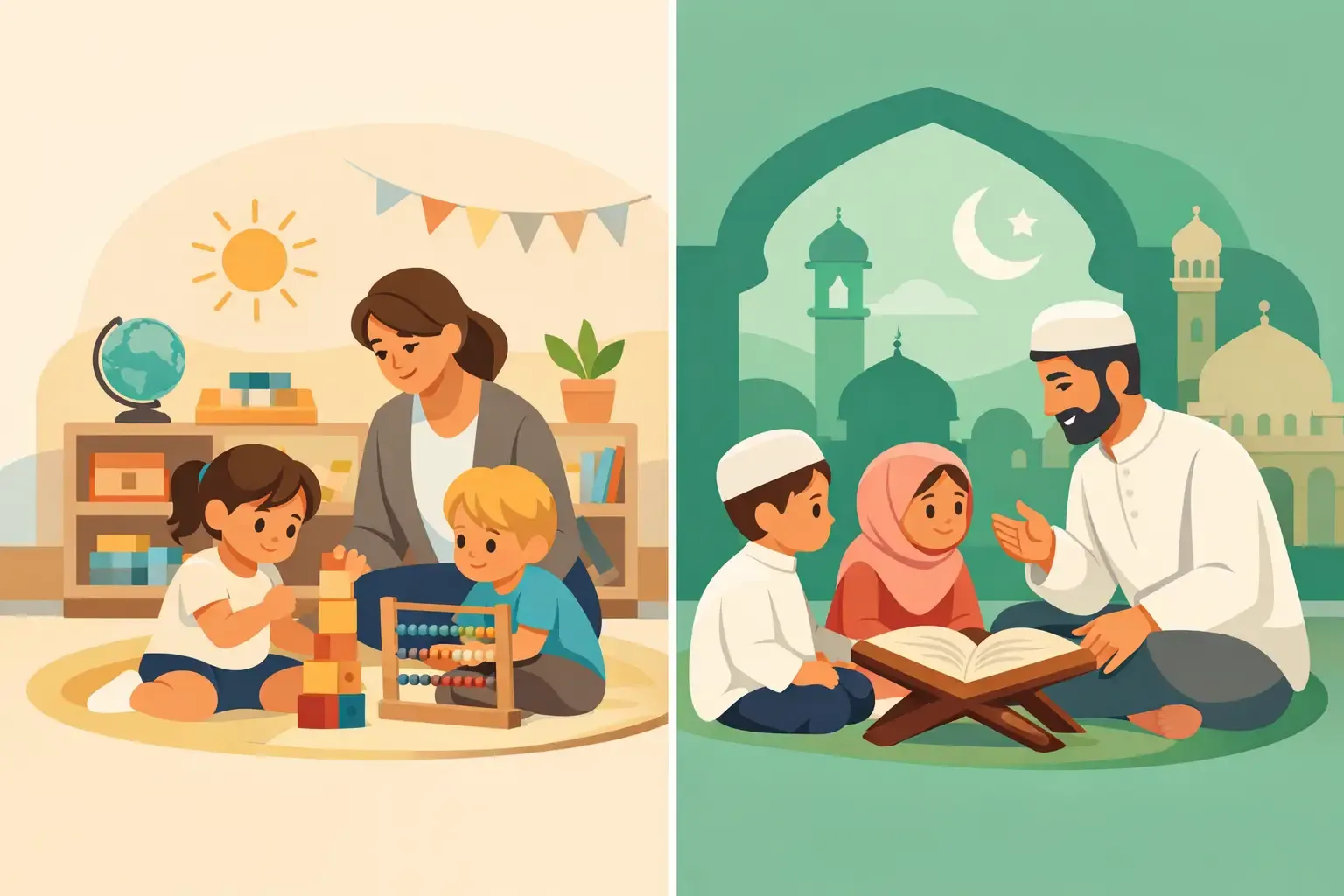
Montessori vs Islamic Preschool for Your Child
The answer is rarely found in a school label alone. Montessori and Islamic preschool programs can share meaningful strengths, especially their respect for the child’s development and growing independence. Yet they may differ greatly in what guides the day, how values are taught, and the place Islam holds in a child’s earliest formation.
What Montessori Preschool Is Designed to Do
The Montessori method is centered on the idea that children learn deeply when they can work independently in a carefully prepared environment. Classrooms typically include hands-on materials arranged at the child’s level, with activities that support practical life skills, sensory exploration, early math, language, and cultural learning.
Instead of directing every activity, the teacher observes, demonstrates how to use materials, and then gives children room to repeat and master a task. A child may choose to button a dressing frame, build the number rods, polish a small object, or work with letter sounds. The goal is not simply to finish an activity. It is to build concentration, order, responsibility, and confidence.
For many families, this approach is appealing because it treats young children as capable learners. Montessori classrooms are often calm, organized, and intentionally designed to encourage self-help. Children may learn to prepare a snack, clean up a spill, carry their own work, and make appropriate choices within clear boundaries.
That said, Montessori quality can vary. Some schools use the name loosely without fully following the method, while others are deeply committed to its materials, training, and multi-age classroom model. Parents should ask how much uninterrupted work time children receive, how teachers guide behavior, and whether the program balances independence with warm relationships and play.
What Makes an Islamic Preschool Different
An Islamic preschool is defined not only by the subjects it teaches, but by the worldview that shapes its care, routines, relationships, and purpose. It supports children’s early development while helping them recognize that they are loved by Allah, part of a Muslim family and community, and responsible for treating others with goodness.
In a thoughtful Islamic setting, faith is not limited to a short Quran or Arabic lesson. It can be present in the way children greet one another with salam, practice gratitude before meals, learn gentleness with friends, hear stories of the prophets, and understand that honesty and kindness matter even when no adult is watching.
A strong Islamic preschool still needs a sound early childhood curriculum. Children require language-rich conversations, active play, early literacy and numeracy experiences, art, movement, science exploration, and social-emotional support. Faith-based learning should strengthen these areas, not replace them. For example, a nature activity can build observation skills while inviting children to notice Allah’s creation. A classroom conflict can become a chance to practice taking turns, making amends, and showing rahmah.
The most effective programs understand that young children learn through repetition, modeling, play, and relationships. They do not expect preschoolers to carry adult levels of religious knowledge. Instead, they create joyful daily experiences that make Islamic identity feel familiar, safe, and meaningful.
Montessori vs Islamic Preschool: The Key Difference
The central difference is the source of the school’s guiding purpose. Montessori is an educational philosophy with a specific approach to independence, materials, observation, and child-led work. Islamic preschool is a values-centered educational environment shaped by Islamic beliefs, character, and community.
This means they are not always opposites. In fact, Montessori-inspired practices can work beautifully within an Islamic early learning environment. Practical life activities can support cleanliness and responsibility. Grace-and-courtesy lessons can reinforce adab. A carefully ordered classroom can help children develop self-discipline. Giving a child time to try independently can nurture both confidence and gratitude for the abilities Allah has given them.
But a Montessori school does not automatically provide Islamic formation, even if it offers a respectful and diverse environment. Likewise, an Islamic preschool does not automatically use Montessori materials or follow a fully Montessori structure. Parents should look beyond the sign outside the building and ask what actually happens throughout the day.
Comparing Daily Learning Experiences
A traditional Montessori classroom often gives children considerable choice in selecting work. The day may include long, uninterrupted periods where children work individually or in small groups. Teachers guide quietly, stepping in when needed and observing each child’s readiness for the next lesson.
An Islamic preschool may have more group routines built into the day, such as circle time, dua, Quran recitation, Islamic stories, nasheed, and community-based activities. Its approach may be play-based, theme-based, inquiry-led, Montessori-inspired, or a combination of methods. The best fit depends on how these routines are delivered. Young children need structure, but they also need movement, choice, hands-on discovery, and time to be children.
For parents, the question is not whether one classroom is more academic than the other. At ages three to six, meaningful learning is often active and concrete. A child who sorts objects, builds a tower, retells a story, negotiates a turn, waters a plant, and asks questions about the sky is developing essential foundations for school and life.
Look for a program that makes learning visible without rushing childhood. Worksheets and memorization alone do not show true readiness. Neither does freedom without guidance. Children thrive when caring adults offer clear expectations, engaging experiences, and patient support.
How Each Approach Supports Character and Independence
Montessori is especially well known for developing independence. Children are encouraged to care for themselves, their work, and their environment. They learn that mistakes are part of learning and that effort leads to mastery. These are valuable habits for every child.
Islamic education adds an intentional moral and spiritual dimension to character building. Independence is not simply about doing everything alone. It is also about using one’s abilities responsibly, serving others, showing humility, and making choices that please Allah. A child who packs away toys can learn responsibility. A child who helps a friend can learn compassion. A child who waits patiently can begin practicing sabr.
This distinction matters because values are caught as much as taught. Parents should notice how teachers speak to children, respond to frustration, guide conflict, and honor each child’s dignity. A school’s character education is most credible when it is visible in adult behavior every day.
Questions to Ask Before Choosing
A school visit should help you understand the lived experience behind the curriculum. Ask how teachers support a child who is shy, frustrated, or still learning to separate from a parent. Ask how Islamic values are woven into play, routines, and behavior guidance rather than taught as isolated facts.
It is also wise to ask about teacher qualifications, class size, outdoor time, safety procedures, parent communication, and the balance between child-led and teacher-guided learning. If a program describes itself as Montessori, ask whether teachers have Montessori training and how the classroom uses Montessori principles. If it describes itself as Islamic, ask how it supports both faith formation and age-appropriate academic development.
Observe the children, too. Do they seem secure and engaged? Are they allowed to speak, move, explore, and make manageable choices? Do teachers redirect with calmness and respect? A beautiful classroom matters, but the emotional climate matters more.
Finding the Right Fit for Your Family
Some families will prefer a dedicated Montessori program because independence and self-directed learning are their highest priorities. Others will choose an Islamic preschool because a consistent faith-centered environment is essential to their child’s identity and daily habits. Many parents are looking for both: modern child development practices within a setting where Islamic values are lived with care and joy.
That is the space a thoughtfully designed program can serve. KinderHive, for example, brings together play-based learning, STEAM experiences, character formation, and Islamic nurturing so children can grow in skills, confidence, and faith without treating these parts of development as separate.
Your child does not need a perfect school. They need a place where they are known, protected, challenged at the right pace, and gently guided toward good character. Choose the environment whose daily practices reflect the future you hope to help them grow into.