
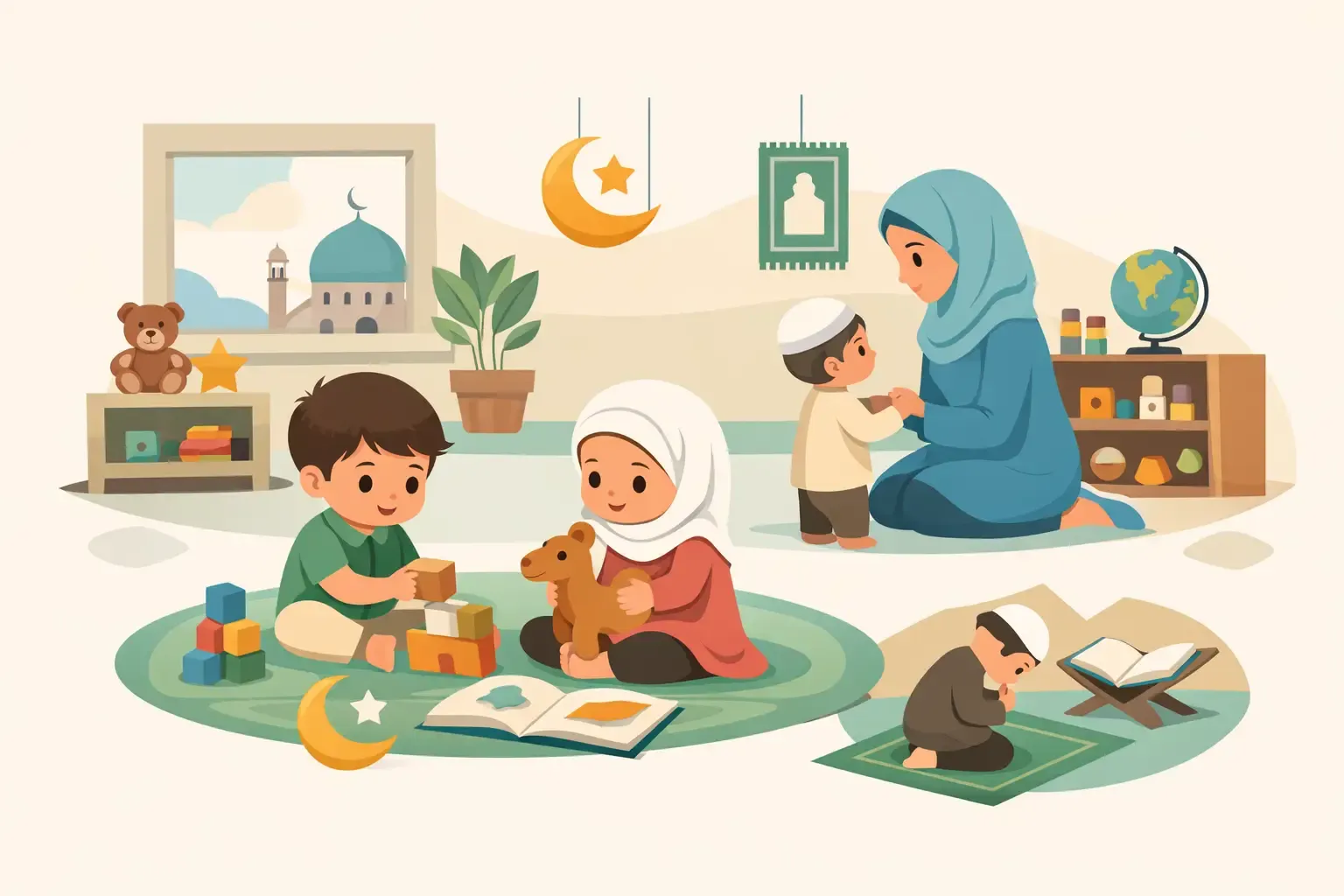
What an Islamic Playschool for Toddlers Should Offer
For Muslim families, this matters because the toddler years are when children begin to absorb routines, relationships, and the emotional meaning behind everyday words. They may not yet understand every lesson, but they can feel kindness, consistency, belonging, and reverence. A strong playschool helps turn those early impressions into foundations that grow with them.
Why the Toddler Years Need Their Own Approach
Toddlers between ages one and three are learning at an extraordinary pace, but they do not learn through long explanations or worksheets. They learn by touching, repeating, moving, copying trusted adults, and trying again. A child who pours water at a sensory table is building coordination and concentration. A child who joins a clean-up song is learning responsibility. A child who is comforted after separation is developing trust and emotional security.
This is why quality early education must be developmentally appropriate. Young children need predictable routines, time for free exploration, responsive teachers, and opportunities to practice simple social skills. They also need rest, nourishment, and reassurance. Academic preparation has a place, but it should never replace play, attachment, or the freedom to develop at an individual pace.
An Islamic setting adds another valuable layer: daily care can be connected to the values families are already teaching at home. Gratitude before a meal, gentleness with friends, respect for adults, care for Allah’s creation, and simple duas can become natural parts of a child’s day rather than separate topics to memorize.
What an Islamic Playschool for Toddlers Should Include
The most effective programs do not treat Islamic learning as one short activity added to an otherwise disconnected day. Instead, values appear through routines, language, stories, and teacher behavior. Toddlers notice how adults speak to them, how conflicts are handled, and whether their feelings are met with patience.
Faith taught through warmth and repetition
For this age group, faith education should be simple, loving, and concrete. Children may learn to recognize phrases such as Assalamu Alaikum, Alhamdulillah, and Bismillah. They may hear short stories about prophets, listen to nasheeds, or explore themes of mercy, sharing, and thankfulness.
The goal is not to expect toddlers to perform perfectly or retain complex religious knowledge. The goal is to help them associate Islam with love, care, beauty, and a sense of belonging. When a teacher gently says, “We use kind hands because Allah loves kindness,” a child begins to connect behavior with a value they can understand.
Play that has a clear purpose
A well-planned playschool day may look relaxed, but it should never be random. Play-based learning gives toddlers meaningful ways to build early skills without pushing them beyond their readiness. Building blocks develops spatial awareness and persistence. Water play supports sensory development. Pretend kitchens and markets encourage language, imagination, and social interaction.
Creative activities should welcome process over perfection. A toddler’s painting does not need to look like a finished product to be worthwhile. The value is in choosing colors, grasping tools, expressing ideas, and feeling capable. Likewise, music, movement, and outdoor play support gross motor development while helping children release energy in healthy ways.
Modern approaches, including early STEAM experiences, can fit beautifully within an Islamic environment. Children can observe leaves, sort natural objects, experiment with floating and sinking, or build simple structures. These experiences encourage wonder about the world Allah created while developing early inquiry skills.
Language, communication, and social confidence
Toddlers are still finding the words for their needs and emotions. A nurturing teacher helps them move from grabbing or crying toward simple communication: “My turn, please,” “I need help,” or “I feel sad.” This takes time, modeling, and calm repetition.
Group activities also give children early experience with listening, participating, and being part of a community. Circle time should be short, active, and age-appropriate. Songs, picture books, finger plays, and simple conversations are more effective than expecting toddlers to sit still for extended periods.
For families raising children with more than one language, a playschool can also support a rich language environment. Exposure to English, Arabic phrases, or a family’s home language can be beneficial when it is warm, consistent, and connected to real experiences. The priority is communication and confidence, not early fluency under pressure.
Safety Is Part of Trust
Parents should be able to see that a school’s care extends beyond a welcoming classroom. For toddlers, safety includes secure arrival and departure procedures, clean learning spaces, age-appropriate equipment, attentive supervision, and clear health practices. It also includes emotional safety.
A child needs teachers who understand that separation tears, frustration, and inconsistent behavior are normal at this stage. Firm boundaries matter, but they should be delivered with calm guidance rather than shame. Ask how teachers help children settle in, respond to biting or pushing, communicate incidents, and support toilet-learning routines when appropriate.
Teacher quality is especially important because toddlers form strong attachments to the adults who care for them. Look for educators who are trained in early childhood development and who demonstrate patience, observation, and genuine affection. A caring teacher does not rush every child through the same milestone. They notice who needs a hand to hold, a quieter transition, or a little more time.
How to Choose the Right Program for Your Child
A school visit can reveal more than a brochure. Notice whether children are engaged, whether teachers speak at the child’s level, and whether the room has space for active play as well as calm moments. Look for materials that are reachable and purposeful, not simply decorative. Most importantly, pay attention to the atmosphere: does it feel orderly without feeling rigid, and nurturing without being unstructured?
It helps to ask how the program balances Islamic values with developmental learning. A thoughtful answer should include daily routines, storytelling, manners, character formation, play, social-emotional support, and school-readiness activities. Be cautious of programs that promise accelerated academics without explaining how they protect a toddler’s need for play and movement.
Consider your own child’s temperament too. Some toddlers thrive with a few short mornings each week before moving into a longer schedule. Others are ready for a fuller routine but need a gradual transition. There is no single ideal timetable for every family. The right choice depends on your child’s age, confidence, sleep needs, previous separation experience, and the consistency your family can maintain.
At KinderHive, this balance is central to the early years experience: Islamic nurturing is paired with structured, play-based learning that respects how young children grow. The purpose is not to make toddlers older before their time. It is to help them become secure, curious, kind, and ready for what comes next.
Partnership With Parents Makes the Difference
The strongest playschool experience continues beyond the classroom. Parents and teachers should share observations about a child’s interests, new words, friendships, routines, and challenges. This kind of communication helps children experience consistency between home and school, especially when they are adjusting to new expectations.
Families can reinforce learning in simple ways. Use familiar duas before meals, invite your child to help put toys away, read stories together, and name feelings without judgment. If your child is learning about sharing at school, practice taking turns during a game at home. Small repetitions build stronger habits than occasional, elaborate lessons.
A meaningful Islamic playschool does more than fill a toddler’s day. It gives them a gentle first experience of community, discovery, and faith in action. When children are met with patient care, purposeful play, and values they can feel, they carry that sense of security forward - one small, joyful step at a time.