
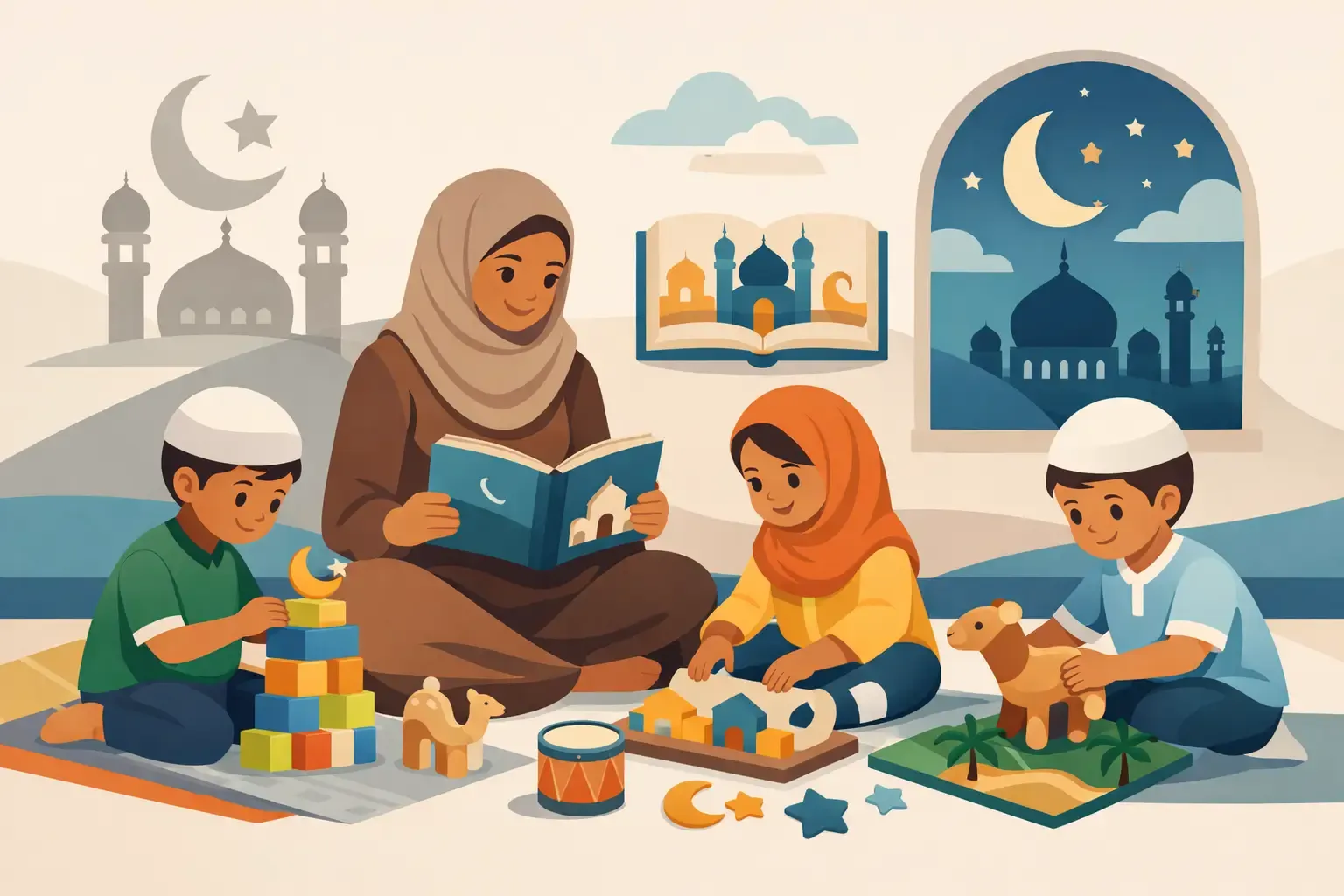
Why Play Based Islamic Learning Matters
For Muslim families, early education is about more than preparing children for kindergarten. It is a formative season for building secure attachment, language, confidence, curiosity, and a loving relationship with Allah. When play and Islamic values are thoughtfully brought together, children can develop these foundations in ways that respect how young minds naturally learn.
What Play Based Islamic Learning Really Means
Play-based learning is not unstructured free time with educational labels added afterward. It is a purposeful approach in which teachers create engaging experiences, observe children closely, ask meaningful questions, and guide learning without taking over. Children learn through movement, pretend play, sensory exploration, stories, music, art, building, conversation, and repeated routines.
In an Islamic setting, the purpose extends further. A child may practice sharing materials while learning generosity, care for a classroom plant while reflecting on Allah’s creation, or use kind words during dramatic play while learning adab, or beautiful manners. Faith becomes connected to real behavior rather than separated into a short activity at the end of the day.
This approach does not mean every block tower needs a religious message. Children also need space to experiment, laugh, make choices, and solve small problems. The Islamic framework is seen in the environment, the language adults use, the relationships children experience, and the values that guide the day.
Why Young Children Learn Best Through Play
Children ages one through six are active learners. They understand ideas by touching, trying, repeating, and talking about what they see. Telling a three-year-old that Allah created the rain may introduce a meaningful idea. Letting that child splash in a water table, listen to rain sounds, paint clouds, and hear a short dua for beneficial rain makes the idea memorable.
Play supports development across several areas at once. As children sort natural objects, they build early math skills. As they retell a prophetic story with simple puppets, they strengthen vocabulary and comprehension. As they negotiate who gets the red truck, they practice self-regulation, empathy, and communication.
This is especially valuable in early Islamic education because character is learned through practice. Patience is not fully understood from a definition. It grows when a child waits for a turn, receives calm support when frustrated, and sees adults model gentle responses. Gratitude becomes more meaningful when children notice the food, family, safety, and abilities Allah has given them.
Faith Becomes Part of Daily Life
A strong early childhood environment makes Islamic identity feel natural and reassuring. Teachers may begin activities with Bismillah, encourage children to say Alhamdulillah after completing a task, and model greetings of peace. These practices are not meant to pressure young children into perfect performance. They create steady, positive associations with faith.
Daily routines are particularly powerful. Washing hands can lead into simple conversations about cleanliness. Snack time can become a chance to practice gratitude and sharing. Helping return toys to their places teaches responsibility and respect for a shared community. Over time, children begin to recognize that Islamic values guide both special occasions and everyday choices.
What Purposeful Play Can Look Like
The best activities are developmentally appropriate, open enough for children to participate in their own way, and connected to a clear learning intention. A teacher does not need complicated materials to make this happen.
During a sensory activity with sand, children might use cups, scoops, and small containers to explore volume and texture. The teacher can introduce words such as full, empty, more, and less while inviting children to notice the beauty and variety in Allah’s creation. For younger toddlers, the goal may simply be safe exploration, language exposure, and turn-taking.
In a pretend-play area, children might prepare food for a family, welcome guests, or care for dolls. Teachers can gently introduce values such as hospitality, compassion, and helping others. A preschool classroom might also create a small market, where children count play fruit, make simple choices, and practice honest, kind exchanges.
Storytelling offers another meaningful bridge. Stories of the prophets, adapted with care for young children, can be paired with props, role-play, drawing, or building. The focus should stay simple and emotionally safe: Prophet Nuh’s perseverance, Prophet Yusuf’s honesty, or the kindness and mercy modeled by Prophet Muhammad, peace be upon him. Children do not need lengthy explanations to begin understanding that good character matters.
The Teacher’s Role Is Active, Not Passive
A common misunderstanding is that play-based learning means adults step back entirely. In reality, skilled teachers are essential. They prepare safe, inviting spaces; know each child’s developmental needs; observe interests; and extend learning with well-timed questions.
Rather than saying, “That is wrong,” a teacher might ask, “What do you think will help your tower stay up?” Rather than forcing a child to apologize immediately after a conflict, the teacher can help name feelings, support repair, and model respectful words. This approach preserves a child’s dignity while teaching accountability.
Teachers also need sound Islamic knowledge and sensitivity. Young children learn from tone as much as words. When faith is presented with gentleness, consistency, and joy, children are more likely to see it as a source of belonging. When expectations are unrealistic or overly corrective, children may become anxious about making mistakes.
Finding the Right Balance Between Structure and Freedom
Families sometimes worry that play will leave children unprepared for academic expectations. This concern is understandable, especially when parents want their children to enter kindergarten confident with letters, numbers, routines, and communication. High-quality play-based learning can support all of these goals.
The difference is in the method. Children may learn letter sounds through name games, story baskets, tracing in sand, and songs. They can build number sense while setting a table, sorting buttons, or comparing block towers. They can strengthen attention through short group gatherings, read-alouds, and carefully designed hands-on tasks.
Still, balance matters. Too little structure can make it hard for some children to settle, while too many adult-directed worksheets can limit creativity and motivation. A well-planned day includes predictable routines, teacher-led moments, outdoor movement, quiet reflection, and meaningful choices. It adapts to age: a two-year-old needs a different pace and expectation than a five-year-old preparing for elementary school.
How Parents Can Extend Learning at Home
Parents do not need to recreate a classroom to support play based Islamic learning at home. The most valuable ingredient is connection. Invite children into ordinary family life and use simple language that links their experiences to faith.
Let a child help rinse vegetables, match socks, water plants, or pack a small bag for a visit. Talk about caring for what Allah has provided, helping family members, and saying kind words. Read short Islamic stories repeatedly, especially if your child asks for the same one every night. Repetition is how young children build language, security, and understanding.
It also helps to allow room for mess, questions, and imperfect attempts. If a child makes a prayer mat from couch cushions or creates a “mosque” with blankets, join the moment with curiosity. Ask what they are making and what they would like to add. The goal is not a polished result. It is a child who feels safe to learn, express faith, and return to caring adults for guidance.
At KinderHive, this kind of learning is supported through an approach that brings together Islamic nurturing, play, early literacy, STEAM exploration, and age-appropriate character development. Children are given opportunities to grow as capable learners while remaining rooted in the values their families hold close.
The early years pass quickly, but the experiences children repeat can stay with them for a long time. When a child learns that curiosity is welcomed, kindness is practiced, and Allah is remembered with love, play becomes far more than a way to fill the day. It becomes a gentle beginning to a confident, faith-centered life.