
Is Islamic Preschool Worth It for Your Child?
The right answer is not automatically yes for every family or every school. Quality matters. Your child’s temperament, your family’s routines, the teachers’ training, and the classroom environment all matter too. But when an Islamic preschool delivers strong early childhood education alongside meaningful faith formation, it can give children a deeply steady start.
What Children Gain From an Islamic Preschool
Early childhood is when children begin to make sense of belonging. They notice the words adults use, the rituals that shape a day, and the ways people treat one another. An Islamic preschool gives children a setting where their Muslim identity is not an occasional topic. It is a natural part of the classroom rhythm.
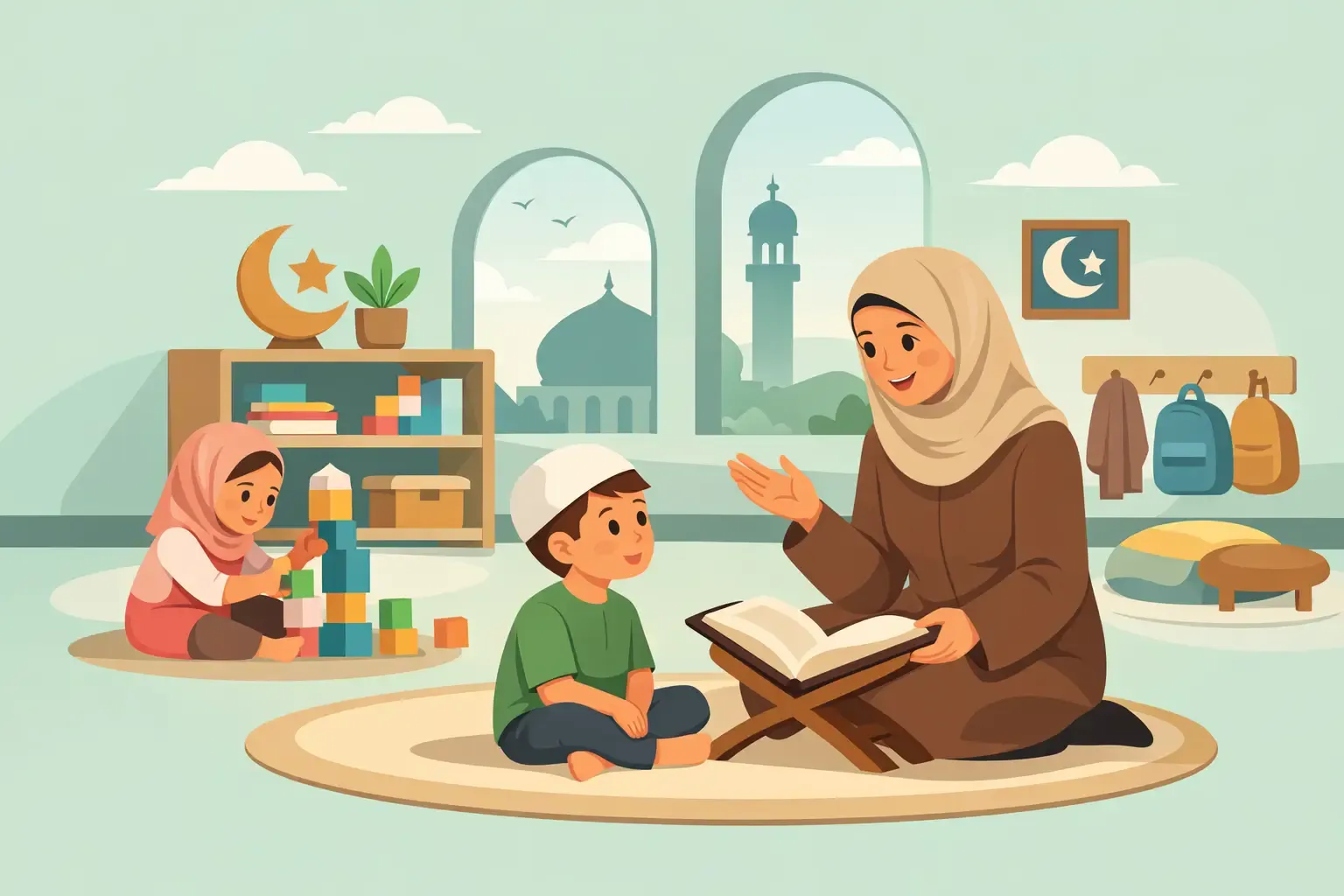
That may look like beginning activities with a simple dua, learning that kindness is part of good adab, hearing age-appropriate stories of the prophets, or practicing gratitude for the people and gifts in their lives. These moments should feel warm and understandable, not heavy or pressured. For young children, faith is often learned through repetition, loving relationships, and everyday examples.
A well-designed program also helps children connect Islamic values to real behavior. Patience becomes waiting for a turn. Amanah becomes putting materials away carefully. Rahmah becomes comforting a classmate who is upset. When values are practiced in ordinary moments, children can begin to carry them from the classroom into home life.
Just as importantly, Islamic education does not need to come at the expense of academic growth. Preschool-aged children need language-rich conversations, hands-on exploration, movement, creative expression, early math experiences, and plenty of play. Strong Islamic preschools weave values into a developmentally appropriate curriculum rather than replacing learning with worksheets or memorization.
Is Islamic Preschool Worth It? Look Beyond the Label
An Islamic name alone does not tell you whether a preschool is the right fit. Families should look closely at what happens in the classroom each day. A meaningful program balances spiritual grounding with the practices children need to thrive socially, emotionally, and academically.
Faith should be lived, not simply displayed
Look for an environment where Islamic values shape teacher-child interactions. Do teachers speak gently and set clear boundaries? Are children encouraged to apologize, help, and show respect? Is religious learning presented with joy and age-appropriate language?
Young children do not need lengthy lessons to form a connection with faith. They need consistent, caring experiences that help them understand that Allah is merciful, that they are loved, and that their choices matter. A school should welcome children’s questions and recognize that each child develops at a different pace.
Play should still be central
A high-quality preschool classroom may look busy, sometimes even a little messy. Children may be building a masjid from blocks, measuring ingredients during a cooking activity, examining leaves outside, painting, singing, or acting out a story. This is not time away from learning. It is how young children learn.
Play-based learning supports problem-solving, communication, self-regulation, and creativity. It can also make Islamic concepts tangible. A child who works with friends to build a community garden, for example, is learning cooperation and care for creation alongside early science and language skills.
Ask how the school approaches literacy, numeracy, science, art, and physical development. The strongest programs use purposeful play and guided teaching, not an overly academic routine that expects preschoolers to sit still for long periods.
Teachers make the greatest difference
A beautiful classroom and a thoughtful curriculum cannot replace skilled, attentive teachers. Preschool teachers need to understand child development, guide behavior respectfully, observe children’s progress, and create secure relationships.
Ask about teacher qualifications, classroom ratios, staff continuity, and how teachers communicate with families. Notice how adults respond when a child interrupts, becomes frustrated, or needs comfort. Those everyday interactions reveal far more than a brochure can.
Teachers should also respect the differences within Muslim families. Children may come from different cultural backgrounds, speak different languages at home, or have varying levels of familiarity with Islamic practices. A welcoming school helps each child feel included without making families feel judged.
The Practical Benefits for Families
For many parents, one of the greatest benefits is alignment. Home and school are not teaching opposite messages about behavior, celebrations, food, modesty, or worship. Children may feel less confused when familiar values are reflected by trusted adults outside their family.
This alignment can make conversations at home easier. If your child learns a dua at school, you can repeat it before meals. If the class talks about generosity, you can invite your child to help prepare a donation or share a toy with a sibling. School becomes a partner in daily nurturing, not a separate world to manage.
An Islamic preschool can also offer community. Parents often value meeting other families who are navigating similar questions about raising young Muslims with confidence and compassion. Children benefit from seeing peers who share parts of their identity, especially during Ramadan, Eid, and other meaningful times of the year.
Programs such as KinderHive aim to pair this faith-centered environment with modern early learning approaches, including play-based experiences and STEAM exploration. That combination matters because children should not have to choose between feeling grounded in their values and being prepared to explore a changing world.
When It May Not Be the Best Fit
An Islamic preschool may not be worth it if the program uses faith as a marketing label but does not meet basic standards for safety, teaching quality, communication, and child well-being. Parents should never feel they must overlook weak practices simply because a school shares their religious identity.
It may also be less suitable if the school’s approach is much more rigid than your family’s needs or your child’s developmental stage. Preschoolers need structure, but they also need warmth, movement, imaginative play, and room to be little. Frequent shaming, excessive pressure to memorize, or discipline that relies on fear are signs to take seriously.
Practical realities matter as well. Consider tuition, travel time, hours, meals, transportation, and whether the school can support your child’s specific needs. A wonderful program that creates daily stress for the whole family may not be sustainable. Sometimes a strong neighborhood preschool paired with intentional Islamic learning at home is the better choice for a season.
Questions to Ask During a School Visit
A school visit should help you see the program in action, not just hear its promises. Ask how teachers support children who are sad at drop-off, how conflicts are handled, and how families receive updates about progress. Ask what a typical day looks like and how much time children spend in active play, outdoor learning, group activities, and quiet rest.
You can also ask how Islamic learning is integrated throughout the week. Are children learning through stories, songs, practical routines, and positive modeling? How does the school observe Ramadan and Eid in ways young children can understand? How are different family backgrounds welcomed?
Watch the children. Do they appear engaged and comfortable? Are they allowed to make choices, ask for help, and move with purpose? Listen to how teachers speak. A calm, respectful classroom is often a stronger sign of quality than perfectly silent children or elaborate displays on the wall.
Choosing With Your Child in Mind
The best preschool is not the one with the most ambitious promises. It is the one where your child can be known well. A shy child may need a gentle transition and a teacher who builds trust slowly. A highly active child may need ample outdoor time and hands-on learning. A child who is eager for stories may flourish with rich language activities and thoughtful Islamic storytelling.
Give yourself permission to ask direct questions and to compare options. Trust the evidence you see, but also pay attention to how the school makes your family feel. You are looking for a place that treats childhood as precious, supports your role as a parent, and helps your child grow in both capability and character.
If a preschool can offer caring teachers, purposeful play, a safe and joyful environment, and Islamic values woven naturally into daily life, it can be a worthwhile investment in your child’s earliest sense of self. The goal is not to rush a child ahead. It is to help them begin with faith, wonder, and the confidence to do good wherever they go.