
How to Teach Islam to a Child Well
For young children, faith is absorbed before it is analyzed. They notice your tone during salah, the words you repeat before meals, the way you speak about kindness, and whether Islam feels heavy or beautiful at home. If parents rush into correction, memorization, and rules without connection, children may learn the words but miss the warmth. A stronger approach is to build Islamic identity the same way healthy early learning is built - through repetition, relationships, play, and lived example.
How to teach Islam to a child starts with connection
Children learn best from people they trust. Before expecting a child to love prayer, Quran, or Islamic manners, it helps to make those experiences feel close and secure. A young child does not separate emotional safety from learning. If Islamic teaching always arrives with pressure, the lesson itself can become stressful.
This is why connection comes first. Sit with your child during a short dua. Let them hear Quran during calm moments, not only during correction. Tell simple stories about the Prophets with warmth and expression. When a child feels that Islam lives inside loving family moments, faith becomes part of belonging.
There is also a practical side to this. Children under seven usually learn through imitation more than abstract explanation. You can explain that Allah loves what is good, but they understand it more deeply when they see patience, gratitude, and honesty practiced daily. In early childhood, your modeling is the curriculum.
Teach belief in simple, concrete language
Adults sometimes make Islamic concepts harder than they need to be. A child does not need complex theology to begin knowing Allah. They need clear language that fits what they can see, feel, and experience.
You might say that Allah made the sky, the rain, animals, and our family. You can tell them Allah hears our duas and loves when we are kind. These are not watered-down ideas. They are foundational truths presented at the right developmental level.
When children ask deep questions, answer honestly but briefly. If a four-year-old asks where Allah is, a simple answer such as, "Allah is above us, and He always knows and sees us," is often enough. If they ask again later, that is healthy. Faith in childhood grows in layers.
It also helps to repeat the same core ideas often. Allah made us. Allah loves truth. Allah wants us to be kind. We thank Allah for our blessings. Repetition builds memory, and memory builds identity.
Focus on the essentials first
Parents sometimes worry about covering everything. In reality, children benefit more from a few strong foundations than many scattered topics. Start with love of Allah, love of Prophet Muhammad, basic duas, gratitude, manners, and familiarity with prayer and Quran. Those essentials create a framework the child can keep growing into.
This matters because early Islamic education is not a race. If a child memorizes many facts but feels disconnected, the outward progress may not last. Slow, steady formation usually goes deeper.
Make daily routines the main classroom
If you are wondering how to teach islam to child in a natural way, look first at your family routines. The most effective Islamic teaching often happens in ordinary moments. Before eating, say Bismillah together. After sneezing, teach Alhamdulillah. At bedtime, recite short surahs or simple duas. When someone is hurt, remind them that Allah loves gentleness.
These small moments work because they are repeated. Children need rhythm. Repetition in context helps them understand that Islam is not only something for Fridays, Ramadan, or formal study time. It belongs in mornings, mealtimes, car rides, clean-up time, and bedtime.
The trade-off is that routine-based teaching can feel slow to adults who want visible progress. But what looks small is often doing the deepest work. A child who naturally says Alhamdulillah, shares with a sibling, and recognizes the sound of Quran is developing an Islamic frame for life.
Use prayer as invitation before obligation
Prayer is one of the clearest examples. Very young children should be welcomed into salah before they are expected to perform it correctly. Let them stand beside you, copy your motions, or use a small prayer mat. If they interrupt, redirect gently. The goal at this stage is familiarity and affection.
Later, as they mature, you can teach accuracy and consistency. But early exposure should feel honorable, not harsh. Children who associate prayer with closeness are usually more open to discipline when the time comes.
Use stories, play, and sensory learning
Young children are not miniature adults. They learn through movement, repetition, imagination, and hands-on experiences. If you want Islamic teaching to stay with them, present it in forms that match how they learn best.
Stories are powerful because they give moral meaning without sounding like a lecture. The story of Prophet Nuh can introduce trust in Allah. The story of Prophet Ibrahim can introduce obedience and courage. The kindness of Prophet Muhammad can shape a child’s understanding of character more effectively than a list of rules.
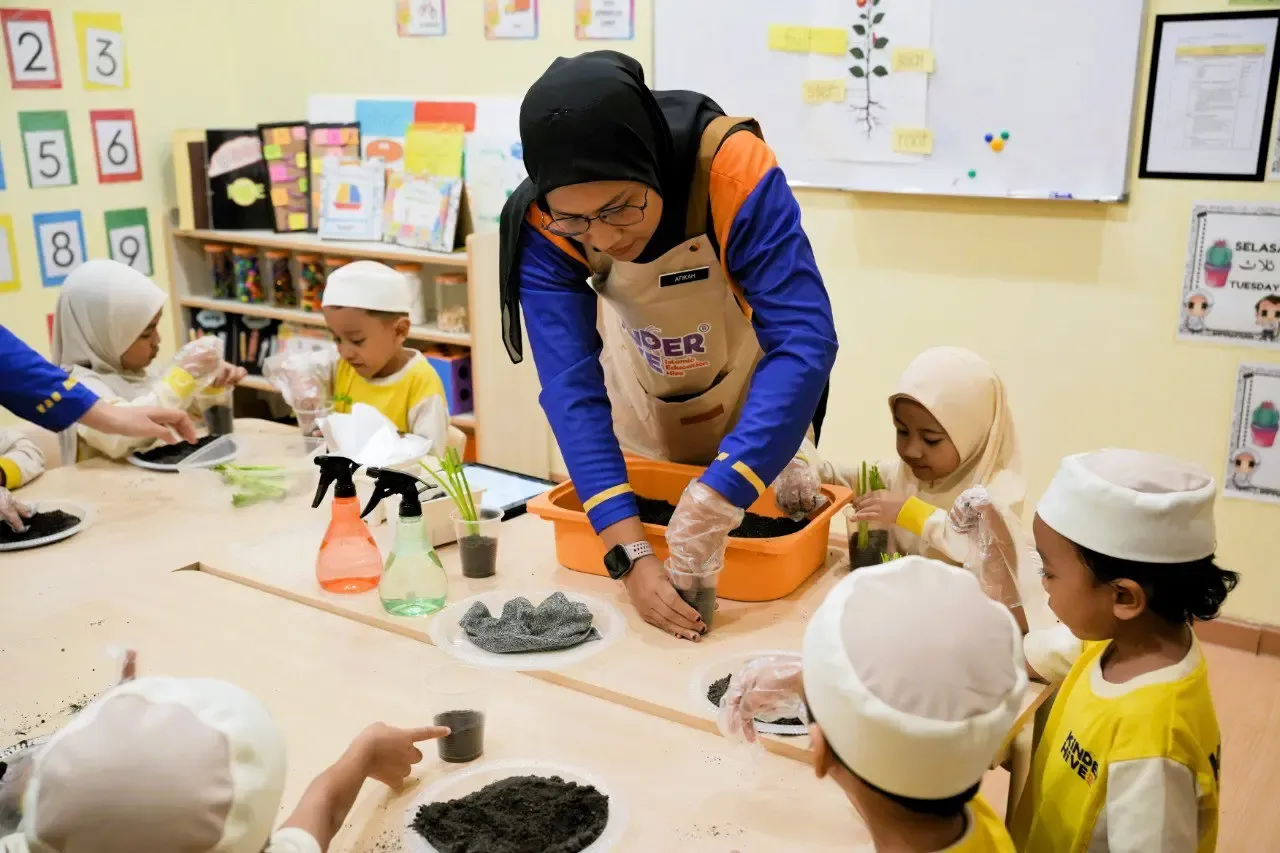
Play matters too. A child can practice taking turns, helping others, and caring for materials as part of Islamic manners. Art activities can connect to themes like gratitude for creation. Nature walks can become opportunities to notice Allah’s signs. Even simple cleanup routines can be tied to responsibility and ihsan.
This is one reason many parents now look for learning environments that combine faith with child development knowledge. A structured, play-based approach does not weaken Islamic education. When done well, it makes Islamic learning more developmentally appropriate and more sustainable.
Teach adab as the everyday face of faith
Many parents ask whether they should focus first on aqeedah, Quran, Arabic, or salah. The answer depends on the child’s age, but adab should be present in all of it. Good manners are not an extra subject. They are one of the clearest ways a child experiences Islam in action.
Teach them to greet others with warmth, speak truthfully, wait their turn, respect elders, and care for younger children. When they make mistakes, correct them with calm firmness. Children need boundaries, but they also need to know that mistakes are part of learning.
Avoid turning Islam into a constant stream of warnings. If a child only hears "don’t do that" in religious language, they may begin to connect faith with shame. They still need correction, of course. But the correction should be proportionate, consistent, and rooted in love.
A helpful balance is to name the good often. "Allah loves when we share." "That was honest." "You showed patience." Positive reinforcement is not indulgence. It helps children recognize what Islamic character looks like in real life.
Keep expectations age-appropriate
One of the biggest challenges in teaching religion to children is expecting maturity before it is developmentally present. A three-year-old may repeat a dua one day and refuse the next. A five-year-old may ask the same question many times. This is normal, not disrespect.
Age-appropriate teaching protects both the child and the parent relationship. Toddlers need short phrases, songs, sensory repetition, and imitation. Preschoolers can begin learning short surahs, simple stories, and reasons behind basic habits. Older children can handle more structure, discussion, and accountability.
If your child resists, it does not always mean the content is wrong. Sometimes the timing, setting, or method needs adjustment. A tired child at the end of the day may not be ready for memorization. A highly active child may learn better through movement than sitting still. Wise teaching responds to the child without lowering the value of the lesson.
Create a faith-filled environment, not isolated lessons
Children are shaped by environment as much as instruction. What they hear, see, repeat, and celebrate becomes normal to them. A faith-filled home does not need to be complicated. It needs consistency.
Let Quran be heard regularly. Keep Islamic books within reach. Mark Ramadan and Eid with joy. Speak about Allah naturally. Let children see adults making dua in real moments of hope, worry, and gratitude. These practices create an ecosystem of belief.
For many families, support also matters. Parents do not have to carry every part of Islamic education alone. Trusted teachers, early childhood programs, and well-designed learning resources can strengthen what begins at home. When that support is grounded in both Islamic values and sound child development, children benefit from consistency across settings, which is one reason many families appreciate structured models like KinderHive.
Your child does not need a perfect parent to love Islam. They need a sincere one - someone who teaches with mercy, repeats with patience, and keeps returning faith to everyday life until it feels as natural as home.