
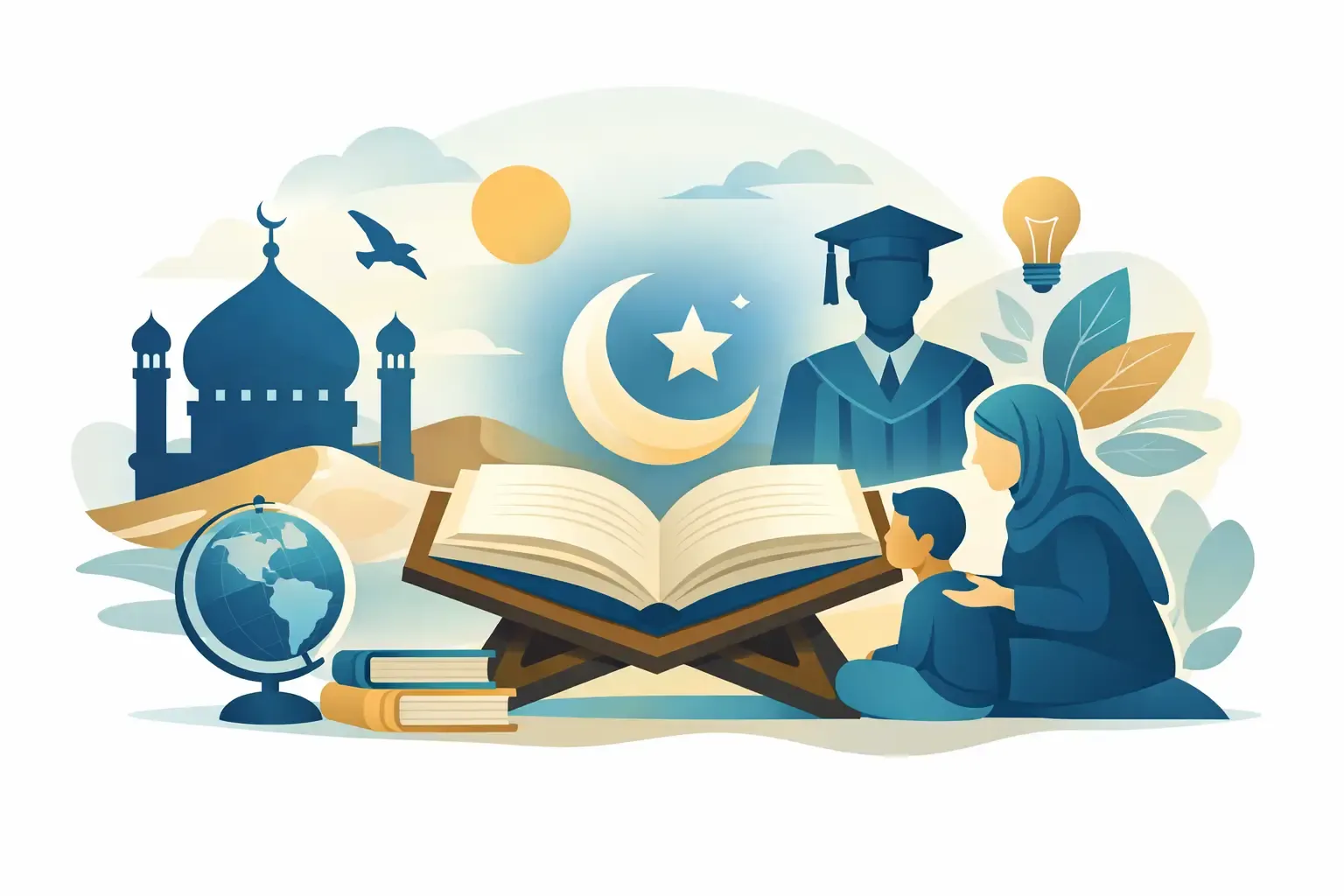
What Are the Aims of Islamic Education?
For many Muslim parents, education is never only about reading readiness, number sense, or classroom routines. Those things matter, and they matter a great deal. But Islamic education asks a bigger question: what kind of human being is this child becoming?
What are the aims of islamic education?
At its heart, Islamic education aims to nurture a person who knows Allah, lives with good character, seeks beneficial knowledge, and contributes goodness to others. It is not limited to religious instruction in a narrow sense. It is a holistic process that shapes belief, behavior, intellect, emotions, and social responsibility.
That matters because children do not grow in separate boxes. A child does not develop spiritually in one hour, emotionally in another, and intellectually somewhere else. Real education works through integration. When a child learns honesty during play, gratitude at mealtime, curiosity during a science activity, and kindness with friends, those lessons are building one whole person.
In Islamic thought, knowledge is not pursued for status alone. It is meant to guide action. A child learns not only what is true, but also how to live in a way that is pleasing to Allah and beneficial to people. This gives education purpose beyond grades or performance.
The aims of islamic education in a child’s daily development
For young children, the aims of Islamic education should be visible in everyday experiences. They are not only found in formal lessons about Qur'an, prophets, or dua. They are also present in routines, relationships, and the emotional tone of a learning environment.
Building faith with love and clarity
One central aim is to develop iman in a way that is age-appropriate, gentle, and rooted in love. Young children first understand faith through trust, repetition, and experience. They hear that Allah created them, loves what is good, and sees their efforts. They learn that prayer matters, that gratitude matters, and that every blessing has a Giver.
For early childhood, this does not mean pushing abstract theology beyond a child’s developmental stage. It means laying a secure foundation. Children need language they can grasp, examples they can observe, and adults who model faith with calm consistency. A warm spiritual environment often teaches more than pressure ever could.
Forming character, not just teaching rules
Another major aim is akhlaq, or noble character. Islamic education seeks to raise children who are truthful, respectful, patient, generous, and mindful of others. This goes beyond behavior management. It is about helping children understand why good conduct matters.
In practice, character formation is slow and relational. A child learns honesty by being told the truth. A child learns mercy by receiving mercy. A child learns self-control through guided practice, not constant correction alone. This is one reason early childhood settings matter so much. The environment itself becomes part of the curriculum.
Encouraging beneficial knowledge
Islamic education also aims to cultivate a love of learning. In Islam, seeking knowledge is an honorable path, but the emphasis is on beneficial knowledge - knowledge that brings a person closer to truth, wisdom, and responsible action.
For children, this can include language, early math, problem-solving, creativity, and discovery of the natural world. There is no conflict in helping a child explore science, build with blocks, ask questions, and develop literacy while also nurturing faith. In fact, when taught well, these areas support one another. Curiosity can deepen wonder. Observation can strengthen gratitude. Structured learning can coexist with spiritual meaning.
Why these aims matter in early childhood
The early years are not a waiting room before real education begins. They are the years when attachment, identity, language, and moral habits are being formed. A child who repeatedly experiences care, order, reflection, and values-based guidance is building patterns that often last far beyond preschool.
This is why the aims of islamic education cannot be postponed until children are older. By age six, children have already absorbed powerful messages about how adults treat them, what is celebrated, how conflict is handled, and whether faith feels close and natural or distant and formal.
There is also a practical reason to start early. Young children learn through imitation and routine. Saying salam, tidying shared spaces, waiting for turns, making dua before eating, and showing kindness to classmates are all developmentally appropriate ways to connect Islamic values to real life. These actions may look simple, but over time they shape identity.
Balancing spiritual growth and modern learning
Some parents feel they must choose between strong Islamic grounding and high-quality contemporary education. In reality, the better question is whether a program knows how to integrate both.
A healthy Islamic education does not reject child development research, play-based learning, language development, or early STEAM experiences. It uses them wisely. Children still need sensory play, rich vocabulary, social-emotional support, movement, and guided inquiry. The difference is that these experiences are framed within a moral and spiritual worldview.
That balance requires care. If a school focuses only on academic outcomes, children may perform well but lack deep grounding in values. If it focuses only on memorization without developmental understanding, children may disengage or fail to connect learning with life. The strongest approach recognizes that readiness for school and readiness for responsible living should grow together.
This is one area where families often look for trusted partners. A brand such as KinderHive reflects this integrated model by combining Islamic values, nurturing care, and modern early learning practices in ways that support the whole child.
The role of parents and educators
Islamic education is never the school’s job alone. Parents are a child’s first teachers, and the home is the first learning environment. Schools and educators can extend, reinforce, and organize that learning, but they cannot replace the daily influence of family life.
That means the aims of Islamic education are best achieved when parents and educators work in alignment. If a child hears about kindness in class but sees harshness at home, the message becomes confused. If gratitude is encouraged at home and reinforced at school, the lesson becomes part of the child’s lived experience.
For educators, this calls for more than subject knowledge. It requires intentional modeling, emotional maturity, and a clear understanding of child development. Teaching Islamic values to young children is not about giving long explanations. It is about using stories, routines, consistent language, and caring relationships to make those values visible.
For parents, it often helps to think in small, repeatable practices rather than grand plans. A short dua together, a calm correction after a mistake, a conversation about Allah’s creation during a walk, or praise for honest behavior can carry more weight than occasional formal instruction.
What success really looks like
The results of Islamic education are not always immediate or easy to measure. A child may not display perfect manners or remember every lesson. Growth is gradual. Young children learn in cycles, and they need repetition, patience, and compassion.
So what does success look like? It may look like a child who begins to remember Allah in ordinary moments. It may look like a child who says sorry with sincerity, shares more willingly, asks thoughtful questions, or shows respect without being forced. Later, it may grow into stronger worship, wiser choices, and a stable Islamic identity.
There is an important trade-off here. Parents naturally want visible progress, but overemphasis on quick results can turn faith into pressure. Children need guidance, but they also need joy, safety, and room to grow. The aim is not to produce outward performance alone. The aim is to cultivate sincere hearts, sound thinking, and good habits over time.
That is why the aims of Islamic education remain so relevant. They give families a framework for raising children who are not only prepared for school, but anchored in faith, guided by character, and equipped to benefit the world around them.
Every lesson, every routine, and every caring interaction can become part of that work. When children are taught with wisdom and mercy, education becomes more than preparation for the next stage. It becomes a way of nurturing who they are before Allah and who they may become for others.