
What Makes an Islamic Preschool Curriculum Work
For Muslim parents, preschool is rarely just about letters, numbers, and classroom readiness. It is also about trust. You want to know that your child is being nurtured in an environment that protects fitrah, builds gentle discipline, and introduces Islamic values in ways that are age-appropriate and meaningful. At the same time, you do not want faith-based learning to come at the cost of strong child development practice. A good curriculum should do both.
What an islamic preschool curriculum should really do
The strongest early years programs do more than add Quran time to a standard preschool schedule. A thoughtful islamic preschool curriculum is designed around the whole child. It supports spiritual awareness, social-emotional growth, language development, physical movement, curiosity, and early academic confidence.
That balance matters because preschool children do not learn in separate boxes. They learn through repetition, imitation, sensory experience, play, and secure attachment. If Islamic learning is treated as a separate subject with abstract language, many children will memorize words without understanding them. If academic learning is pushed too hard without room for movement and exploration, children may perform on paper but lose the joy and confidence that should define these years.
A well-built curriculum respects developmental stages. Children ages 1 to 3 need exposure, rhythm, language, and loving routines. Children ages 4 to 6 can begin to engage more intentionally with stories of the Prophets, simple duas, adab, pre-literacy, early numeracy, and structured inquiry. The methods should shift with age, but the goal remains consistent: helping children grow as confident learners and young Muslims with strong foundations.
Faith formation starts with lived experience
At preschool age, Islamic education is not primarily about complexity. It is about familiarity, love, and consistency. Children should hear the names of Allah in warm contexts, practice gratitude in daily conversation, and see teachers model patience, honesty, cleanliness, and kindness.
This is why environment matters as much as content. If a classroom speaks about mercy but feels harsh, children absorb the contradiction. If children are taught respect but are not treated with dignity, the lesson weakens. In early childhood, the hidden curriculum is powerful. Tone of voice, transitions, routines, and teacher responses are all part of faith formation.
Stories also play a central role. Young children connect deeply with narrative, especially when it is repeated and connected to real-life behavior. A story about Prophet Nuh can support conversations about obedience and trust. A simple lesson about sharing can be tied to sadaqah and caring for others. These links should be gentle and concrete. Preschoolers learn best when values are embodied, not over-explained.
Play-based learning is not separate from Islamic learning
Some parents still worry that play-based classrooms are too loose or not academic enough. Others worry that faith-based schools may become too rigid or worksheet-heavy. In reality, these are not the only two options. The best preschool models integrate purposeful play with clear developmental goals.
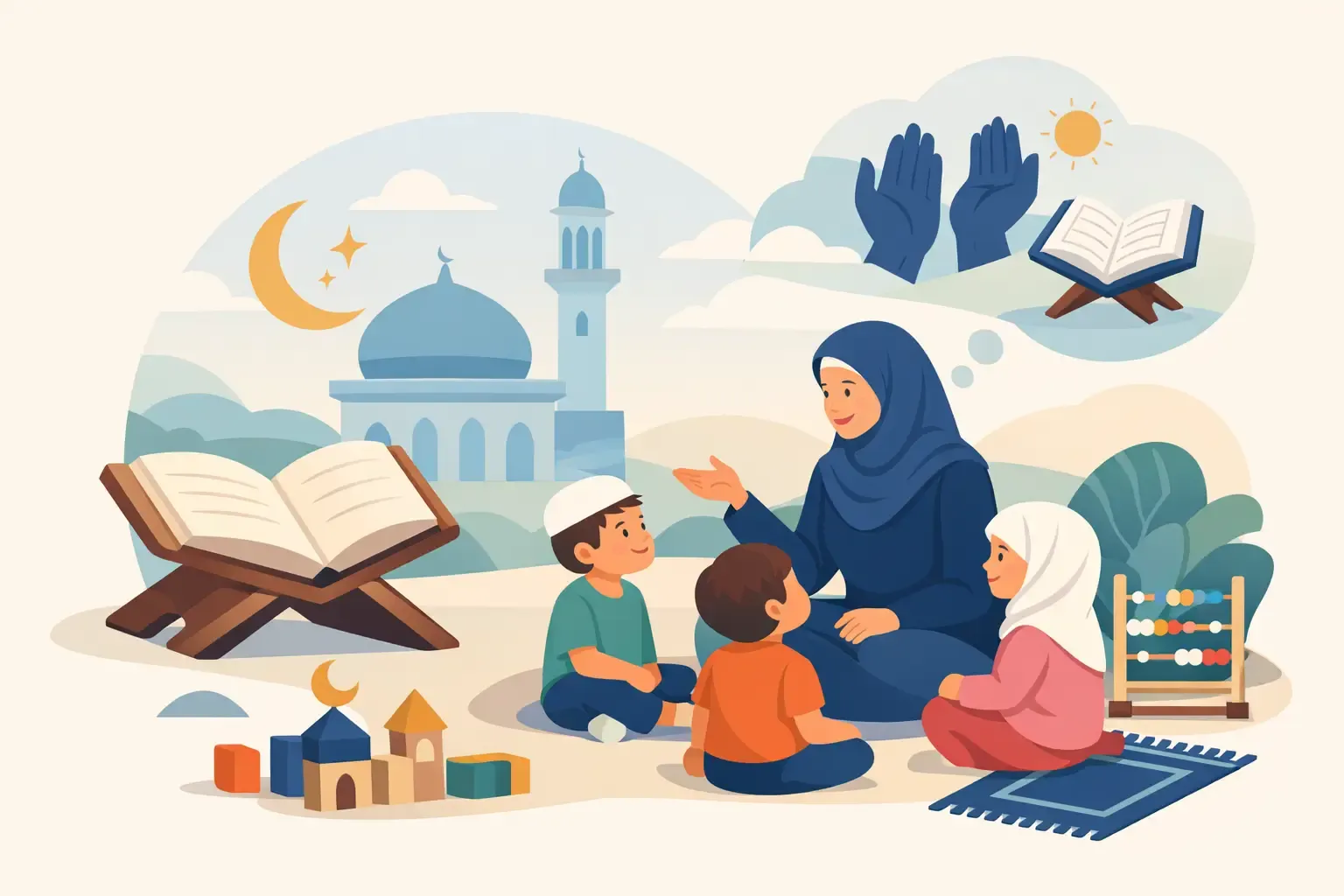
Play is how children test ideas, practice language, build self-regulation, and develop problem-solving skills. In an Islamic setting, it also becomes a space where adab, cooperation, stewardship, and creativity can be practiced naturally. A child building a masjid from blocks is learning spatial thinking and symbolic representation. A child taking turns in a pretend market is learning social negotiation, vocabulary, and fairness.
This does not mean everything has to be labeled Islamic to be valuable. Sometimes faith integration is direct, and sometimes it is embedded in the way the classroom functions. Wonder, order, reflection, and care for creation all support an Islamic worldview when they are guided well.
School readiness should include character, not just academics
Families often ask whether a preschool will prepare their child for elementary school. That is a fair question, but readiness should be understood broadly. A child who can recite the alphabet but cannot separate confidently, follow routines, listen in a group, or manage emotions is not fully ready. The same is true spiritually. A child may memorize short phrases, but readiness in faith also includes habits of respect, awareness of Allah, and comfort with Islamic identity.
A strong preschool curriculum develops early literacy and numeracy in ways that fit young children. It builds phonological awareness, vocabulary, fine motor control, number sense, and curiosity. But it should also cultivate self-help skills, empathy, attention, resilience, and communication.
These areas are deeply connected. When children are secure and emotionally regulated, they are more available for learning. When routines are predictable and values are consistent, they feel safe. When teachers understand development, they can support both academic growth and character formation without forcing one at the expense of the other.
What parents should look for in an Islamic preschool curriculum
Not every program that uses Islamic branding offers the same level of quality. Some are sincere but limited. Others may be academically organized but weak in nurturing practice. Parents should look beyond surface features and ask how the curriculum works day to day.
The first sign is developmental appropriateness. Preschool children should not be expected to sit for long periods, memorize beyond their understanding, or produce work that mainly satisfies adults. Lessons should be hands-on, language-rich, and realistic for the age group.
The second sign is integration. Islamic values should not appear only during one subject block. You should be able to see them in routines, conflict resolution, classroom language, celebrations, and teacher modeling.
The third sign is structure. Warmth alone is not enough. A credible program has clear learning goals, age-based progression, teacher guidance, and systems for observation and communication with families. Children thrive when care and structure come together.
The fourth sign is partnership with parents. Preschool works best when school and home reinforce one another. Families should receive insight into what children are learning, why it matters, and how simple habits at home can support consistency.
The role of modern pedagogy in an Islamic setting
Modern early childhood practice is not a threat to Islamic education when used wisely. In many cases, it strengthens it. Child development research helps educators understand attention span, sensory regulation, language growth, and the role of play. Approaches such as STEAM, inquiry, and experiential learning can support a child’s natural curiosity while keeping values at the center.
The key is not to copy trends uncritically. It is to filter methods through purpose. Technology, for example, can enrich learning when used intentionally and in moderation. Visual media, audio support, and interactive tools may help reinforce concepts, but they should never replace human connection, movement, and hands-on exploration.
The same applies to academic acceleration. More is not always better in the early years. A preschool that pushes children into formal outcomes too early may look impressive at first, but it can create stress, reduce intrinsic motivation, and overlook foundational developmental needs. Strong early education builds deeply, not just quickly.
This is where a structured ecosystem can make a real difference. When schools, teachers, and families are supported by aligned resources such as guided content, books, digital tools, and clear educational frameworks, children experience continuity across environments. That consistency supports both learning and identity.
Why consistency matters more than intensity
Many parents hope preschool will give their child a strong Islamic foundation, and that hope is valid. Still, foundations are not built through pressure. They are built through repetition, warmth, and meaningful practice.
A child who learns to say salam sincerely, tidy up after play, listen during a story, care for friends, and connect everyday blessings to Allah is building something durable. These practices may seem simple, but they shape identity over time. Preschool should plant seeds that families can continue watering at home.
This is also why teacher quality matters so much. The curriculum on paper is only one part of the picture. Young children learn through relationships, and teachers carry the responsibility of turning values into lived experience. They need training not only in Islamic content, but also in classroom management, developmental observation, communication, and nurturing guidance.
Parents are right to look for a program that feels spiritually grounded and educationally sound. The best answer is not choosing one over the other. It is choosing a preschool experience where faith, learning, and child development are designed to work together.
When that happens, children do not just prepare for the next grade. They begin to see that learning itself can be an act of growth, gratitude, and closeness to Allah.