
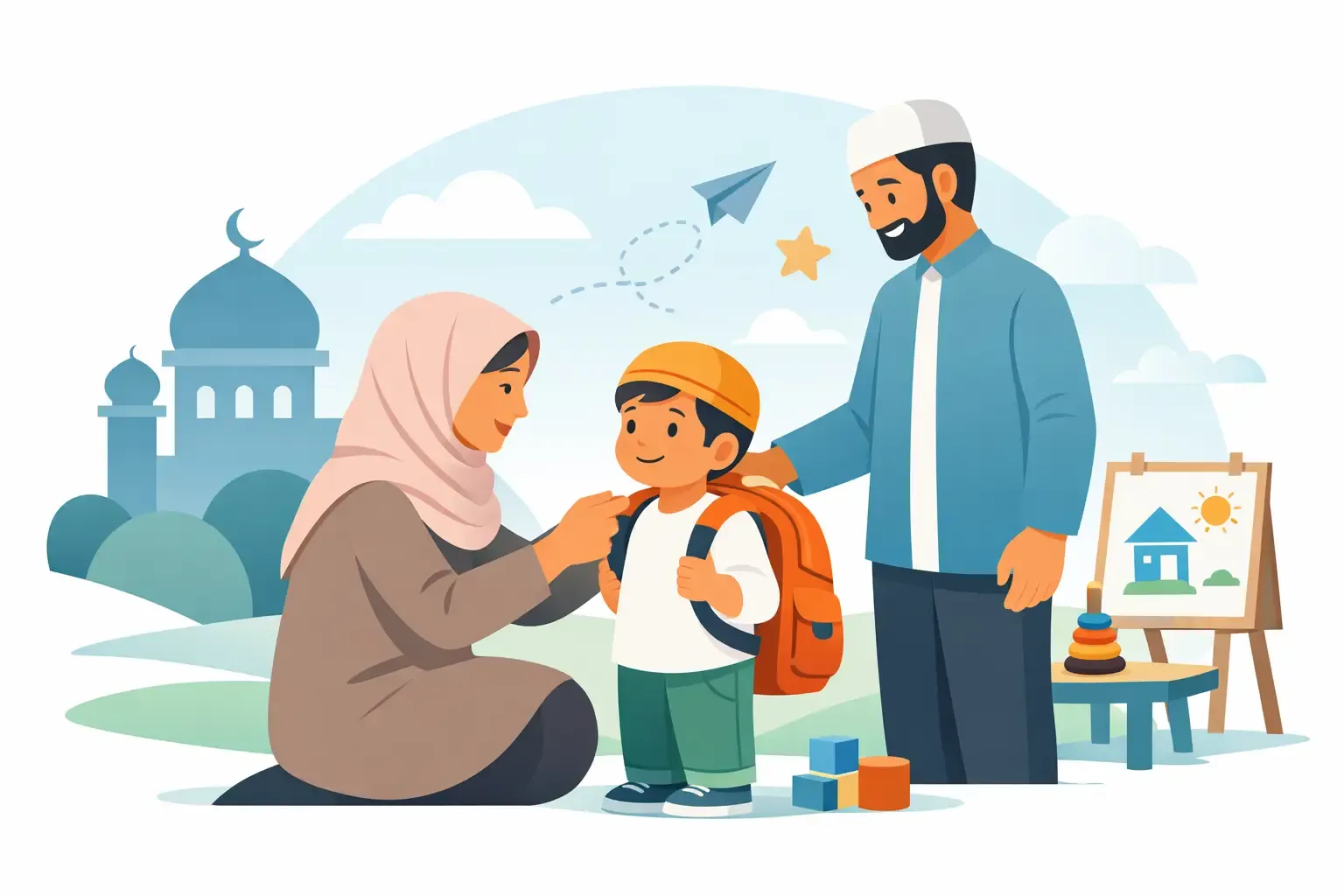
Kindergarten Readiness for Muslim Families
Readiness is not about having a child who can already read chapter books, sit still for long periods, or recite every answer perfectly. It is about helping children build the practical, social, emotional, and spiritual foundations that allow them to participate, learn, and grow.
What Kindergarten Readiness Really Means
Kindergarten is a major transition because children are asked to manage many new things at once. They listen to adults outside their family, follow a daily routine, share attention and materials, express their needs, and recover from small disappointments. Academic skills matter, but they are only one part of the picture.
A ready child is developing across several connected areas. They can usually communicate in an understandable way, recognize some letters and numbers, hold a crayon with growing control, and enjoy stories. Just as importantly, they are learning to wait for a turn, separate from a parent with support, follow simple directions, and keep trying when an activity feels difficult.
Children develop at different rates. A quiet child may be deeply observant and ready to learn, while an outgoing child may still need support with listening and routines. Readiness is not a pass-or-fail test. It is a useful way to notice what your child already does well and where a little practice may help.
Kindergarten Readiness for Muslim Families Starts at Home
For Muslim families, faith can make everyday preparation more meaningful rather than adding another item to a busy checklist. Islamic values are often learned best through consistent small moments: saying bismillah before eating, offering salaam when entering a room, showing kindness to a sibling, and helping care for shared spaces.
These habits support school readiness in practical ways. A child who practices gratitude learns to notice others. A child who helps put away toys is learning responsibility. A child who is guided to use gentle words when upset is building emotional regulation. These are not separate from early education. They are part of the character that helps a child belong in a classroom community.
It helps to speak about kindergarten as a place where your child can be curious, helpful, and brave. You might say, “Allah gave you a mind to learn and a kind heart to care for others.” This reassures children that faith is not left at the classroom door. It remains a source of comfort and good choices throughout their day.
Build independence through daily routines
Independence does not mean expecting a young child to do everything alone. It means giving them manageable opportunities to try, with calm support nearby. Before kindergarten begins, invite your child to practice opening a lunch container, putting on a jacket, washing and drying hands, using the toilet independently when developmentally appropriate, and placing belongings in a designated spot.
Simple routines can reduce stress during the first weeks of school. Let your child choose between two appropriate outfits, carry a small bag, or help pack a snack. When they struggle, resist rushing in immediately. Offer a short prompt such as, “Try the zipper again. I am here if you need help.” The goal is confidence, not perfection.
Strengthen language through warm conversation
Children do not need formal worksheets to prepare for language learning. They need rich conversation. Talk about what you see on a walk, ask your child to retell part of their day, and read aloud every day. Pause during stories to ask what a character might feel or what could happen next.
If your family uses Arabic, Urdu, Malay, or another home language alongside English, continue using it with pride. A strong home language supports identity, family connection, and communication. Children can learn English while maintaining the language of their du'a, grandparents, and family stories. The key is regular, meaningful exposure to language, not pressure to sound advanced before school begins.
Make early math and science part of play
Young children learn best when ideas have a purpose. Count dates as you place them on a plate, sort laundry by color, compare which cup holds more water, or notice the moon’s changing shape. Building towers, mixing ingredients, planting seeds, and exploring magnets all develop early STEAM thinking.
Play also teaches persistence. When a block tower falls, a child has the chance to test a new idea instead of hearing that they failed. This flexible thinking will serve them well in kindergarten, where learning often involves trying, adjusting, and trying again.
Social and Emotional Readiness Needs Practice
Many parents focus first on letters, numbers, and pencil grip. Yet the ability to manage feelings can have an even greater effect on a child’s school experience. Kindergarten classrooms are busy places. Children need time to learn how to cope when someone else gets the preferred seat, when a game changes, or when they miss home.
Name emotions in ordinary moments: disappointed, frustrated, proud, nervous, and excited. Then give your child a few simple responses to practice. They can take a slow breath, ask an adult for help, use words such as “Can I have a turn when you are done?”, or move to another activity for a moment.
Role-play can make these skills feel familiar. Pretend to be a classmate who takes a toy, a teacher who gives a direction, or a child who looks lonely at lunch. Guide your child toward respectful responses rooted in adab: using kind words, listening carefully, and treating others with dignity.
Separation can be especially tender for children who have spent most of their early years with family. Short experiences with trusted relatives, playgroups, or structured early learning programs can help. Keep goodbyes warm and brief. Promising to return after a clear part of the day, such as after snack or at pickup time, is more reassuring than quietly slipping away.
Choose a School Environment That Sees the Whole Child
A school’s approach matters as much as a child’s preparation. Look for an environment where teachers understand early childhood development and recognize that young children learn through movement, play, questions, repetition, and relationships.
For Muslim families, it is also reasonable to ask how the school respects your child’s identity. This may include space for prayer when appropriate, sensitivity around halal food, respectful recognition of Islamic celebrations, and educators who welcome conversations about family values. The exact fit depends on your family and the school setting, but your child should never feel that faith is something to hide.
A high-quality Islamic early education setting can bring these priorities together. At KinderHive, children are supported through play-based learning, early STEAM experiences, and character formation rooted in Islamic values. The aim is not to rush childhood. It is to give children a secure foundation from which curiosity, compassion, and capability can grow.
Before enrollment, ask how teachers communicate with families, handle big emotions, introduce literacy and numeracy, and support children who need extra time to adjust. A school that offers clear routines and a partnership with parents can make the transition feel far more manageable.A Gentle Plan for the Weeks Before School
In the month before kindergarten, gradually shift bedtime and morning routines toward the school schedule. Visit the school or drive by it if possible, and talk through what drop-off may look like. Read books about starting school, but leave room for your child’s honest reactions. Excitement and nervousness can exist together.
Avoid turning every interaction into a lesson. A child who feels constantly tested may become anxious about school. Instead, create a rhythm of short practice, plenty of play, family connection, and rest. Notice effort specifically: “You kept working until you opened your container,” or “You used kind words when you were upset.”
Pack familiar comfort into the transition where school policy allows, whether that is a small family photo in a backpack or a reassuring phrase your child can repeat. A simple du'a before leaving home can also become a steady anchor: asking Allah for ease, beneficial knowledge, and kind companionship.
Your child does not need to arrive at kindergarten knowing everything. They need to arrive knowing that home is safe, learning can be joyful, mistakes are part of growing, and Allah is near. That is a strong beginning for any classroom.