
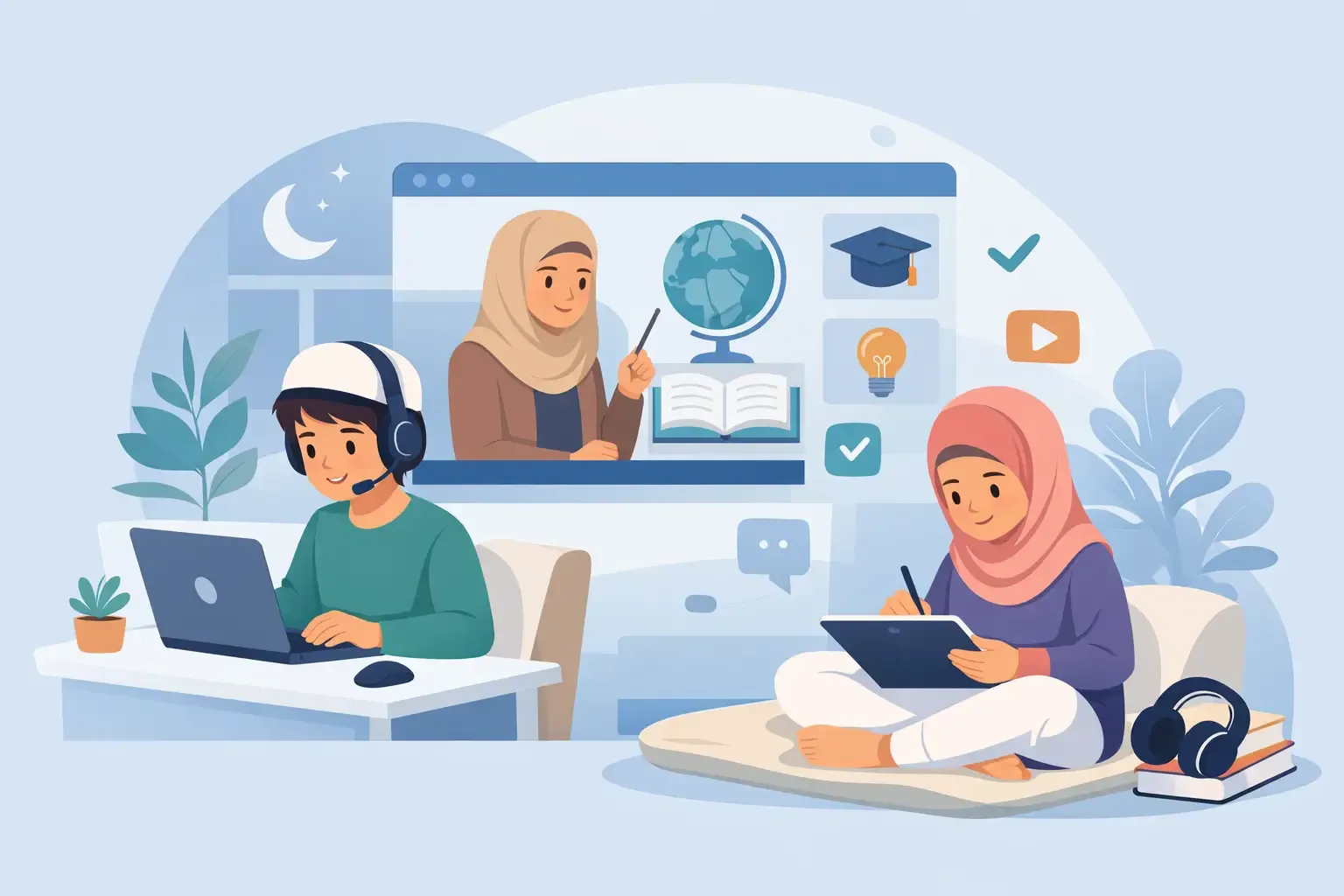
Digital Learning for Muslim Children at Home
For young children, the goal is not to keep up with every new app or turn a tablet into a classroom. It is to choose experiences that support the way children actually learn: through repetition, movement, stories, conversation, and loving guidance. When digital tools are used with purpose, they can reinforce the values families are already nurturing at home.
What meaningful digital learning looks like
A high-quality digital activity for a young Muslim child should feel active, even when a screen is involved. A short nasheed may invite clapping and actions. A story about kindness may lead to a conversation about sharing toys. A letter game may become a chance to notice Arabic sounds in a familiar du'a.
The screen is only one part of the experience. The real learning happens when a child responds, practices, asks questions, and connects what they see to daily life. This is especially true in the early years, when children need real relationships and hands-on exploration to build language, confidence, and emotional security.
Faith-centered content also gives children words for what they are already experiencing. They can learn that saying Bismillah comes before eating, that Allah made the animals they see outside, and that helping a sibling is an act of good character. These lessons become more memorable when they are presented in a warm, joyful, age-appropriate way.
Digital learning for Muslim children starts with purpose
Before choosing a video, game, or learning platform, parents can ask one simple question: what do I hope my child will gain from this? The answer may be early literacy, number awareness, Arabic vocabulary, a calming bedtime routine, or a clearer understanding of Islamic manners.
A purpose helps families avoid passive viewing. Not every educational label means a program is developmentally suitable, and not every Islamic video supports meaningful understanding. Some content moves too quickly, relies on overstimulation, or presents information without giving children time to think. For toddlers and preschoolers, slower pacing and familiar repetition are often more valuable than flashy effects.
It also helps to select content that reflects Islam with gentleness and joy. Young children need to experience faith as a source of love, gratitude, belonging, and good character. They do not need long explanations or adult-level lessons. A simple story, a kind phrase, or a brief reminder can be enough when it is repeated consistently.
Keep the adult in the learning experience
Co-viewing is one of the most effective ways to make digital learning more valuable. Sitting nearby gives parents the opportunity to pause, smile, repeat a new word, or connect a lesson to a child’s own day. A child who watches a story about caring for others can be asked, “How can we show kindness to someone today?”
This does not mean every activity requires a long discussion. With very young children, a few warm words are enough. “That was a beautiful du'a.” “Can you show me the color blue?” “Let’s say Alhamdulillah for our food.” These small exchanges build vocabulary while showing children that learning is something they do with the people who care for them.
There are times when independent screen use may be practical, especially while a parent prepares a meal or handles another responsibility. Families do not need perfection. The aim is to make shared learning the regular pattern, rather than expecting a device to carry the full responsibility for education or spiritual development.
Build a rhythm, not a screen-heavy schedule
Consistency matters more than length. A brief digital activity at a predictable time can feel reassuring to children and easier for parents to manage. For example, a family may choose a short Arabic sound activity after breakfast, a character story in the afternoon, or a calming Islamic reminder before bed.
Then move the learning away from the screen. If children watched a lesson about shapes, let them find circles and squares around the home. If they practiced a nasheed about gratitude, invite them to name one blessing from their day. If they heard a story about cleanliness, let them help organize their books or wash their hands before a meal.
This approach protects time for the activities children need most: physical play, sleep, conversation, pretend play, outdoor discovery, and family routines. Digital learning should complement these experiences, not replace them. The right balance will depend on a child’s age, temperament, family schedule, and ability to transition calmly when the device is put away.
Choose content that supports whole-child growth
Parents often look first for alphabet, number, or Quran learning resources. These are valuable, but early childhood development is broader than academic readiness. Children also need help recognizing feelings, taking turns, solving small problems, using their imagination, and developing confidence.
The strongest digital resources support more than one area of growth. A story can build listening skills and empathy. A creative drawing prompt can strengthen fine motor practice after the screen is off. A simple science activity can encourage children to observe Allah’s creation with wonder. Play-based learning and early STEAM experiences can sit naturally alongside Islamic values when both are rooted in curiosity, responsibility, and care.
Look for clear language, calm visuals, respectful representation, and activities that invite participation. It is also wise to preview content before sharing it. Parents know their child best, including which themes feel comforting, which characters capture their attention, and which experiences may be too intense or confusing.
Let Islamic values appear in everyday moments
Digital resources are most helpful when they strengthen routines children can practice. A child may learn a short phrase through a video, but the phrase takes root when it is used at the table, in the car, or before sleep. In the same way, a lesson about honesty matters most when adults notice and praise honesty in real life.
Try to connect one digital lesson to one daily action. After a lesson about gratitude, create a family habit of sharing something to say Alhamdulillah for. After learning about kindness, encourage a child to make a drawing for a grandparent or help set the table. After hearing a story about prayer, let a child stand beside the family with their own small prayer mat.
This connection gives children a lived Islamic identity. Faith is not something that only appears in a lesson or on a screen. It becomes part of how they greet others, care for their belongings, speak to family, and understand the world around them.
Watch for signs that the balance needs adjusting
Even good content can become unhelpful when it is used too often or at the wrong time. If a child becomes distressed when the device is removed, struggles to settle before sleep, loses interest in toys, or begins asking for screens during every quiet moment, it may be time to reset the routine.
Start with simple boundaries. Keep devices out of meals and bedrooms where possible. Give a clear warning before an activity ends, then offer a next step such as blocks, coloring, a snack, or outdoor play. When children know what comes after the screen, transitions often become easier.
Adults can model this balance too. Children notice when phones interrupt conversations or family time. Protecting device-free moments, especially around meals, prayer, and bedtime, sends a powerful message about attention, respect, and presence.
A trusted ecosystem can support the family
Parents should not have to piece together every lesson alone. A thoughtful early education ecosystem can bring together play-based activities, Islamic stories, parent guidance, books, videos, and developmental learning goals in ways that feel connected rather than overwhelming. KinderHive approaches early learning as a partnership with families, helping children grow in knowledge, character, confidence, and faith.
The most valuable resource is not necessarily the one with the most features. It is the one that fits a child’s stage of development, reflects a family’s values, and inspires meaningful moments beyond the device. A short story that leads to a child choosing kindness may have more lasting value than an hour of passive educational content.
As children grow, their digital experiences will grow with them. The foundation to protect now is simple: let technology support the relationship, the routine, and the values that make a child feel secure, curious, and close to Allah.