
Childcare Versus Preschool: Which Fits Your Child?
For Muslim families, there is another meaningful consideration: whether a setting supports the values children are beginning to absorb every day. The earliest years are not only about learning letters and numbers. They are also when children learn gentleness, independence, gratitude, respect, and the comfort of turning to Allah in daily life.
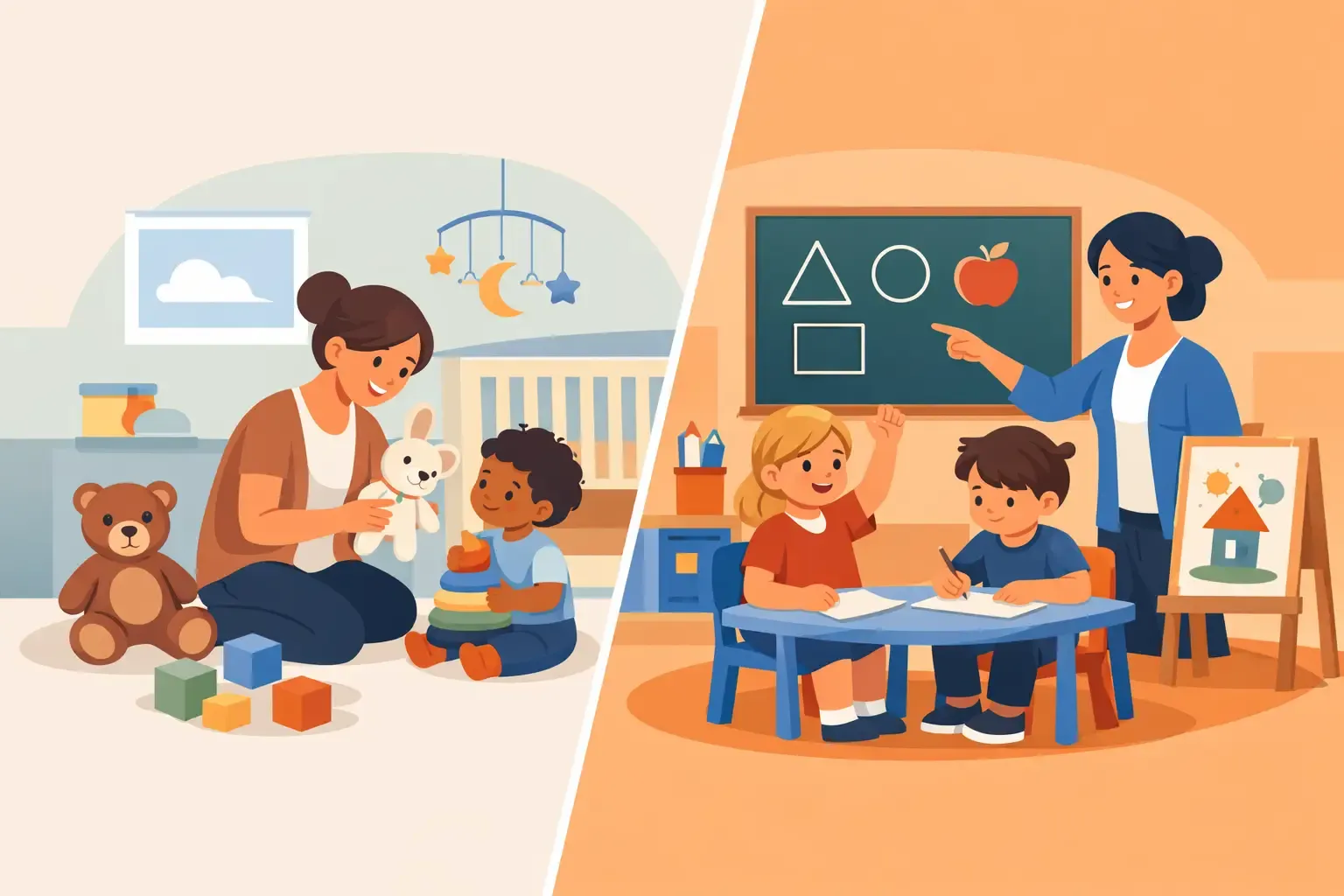
Childcare versus preschool: the central difference
Childcare is primarily designed to provide consistent supervision and care for young children while parents work, study, or manage other responsibilities. Programs may serve infants through preschool-age children, often for a full day and throughout the year. A quality childcare setting does far more than keep children occupied. It supports routines, meals, rest, social interaction, movement, and age-appropriate play.
Preschool is primarily an early education program, usually for children ages 3 to 5. Its purpose is to build the skills children need for the next stage of learning. The day may be shorter, such as a morning or afternoon program, although many preschools also offer extended-day care. Preschool commonly follows a more planned curriculum with activities that develop language, early math, creativity, motor skills, social confidence, and self-help abilities.
The distinction can blur. Many childcare centers have strong educational programs, and many preschools provide full-day care. Rather than relying on the label alone, ask what happens during the day, who guides the children, and how the program responds to each child’s developmental needs.
What a strong childcare program can offer
For a young toddler, care and learning are inseparable. A caring teacher who speaks gently during diaper changes, invites a child to name a feeling, or helps two children take turns is teaching essential skills. The child may not be sitting for formal lessons, but they are learning trust, communication, and how to belong in a group.
A thoughtful childcare environment should have predictable routines without becoming rigid. Young children benefit from knowing what comes next: arrival, play, snack, outdoor time, rest, and pickup. Consistency helps them feel safe enough to explore.
Look closely at how the program handles the everyday moments that matter most. Are teachers responsive when a child is upset? Are nap arrangements appropriate for your child’s age? Is active play part of the day? Are classrooms clean, calm, and designed for little hands? Ratios, staff training, and low teacher turnover also matter because relationships are at the heart of quality care.
For Muslim families, values can be present in simple, natural ways. Children can practice saying bismillah before meals, learn to care for others, hear stories that build good character, and experience a respectful environment where their identity is understood. This should never feel forced or limited to a single activity. The strongest faith-centered care reflects mercy, adab, and gratitude throughout the day.
What preschool adds for growing learners
Preschool becomes especially valuable when children are ready to participate in more intentional group learning. This does not mean long worksheets or pressure to read early. Meaningful preschool education is active. Children learn through stories, building, music, pretend play, art, experiments, conversation, and outdoor discovery.
A well-designed preschool curriculum helps children recognize sounds, expand vocabulary, count objects, notice patterns, use scissors, hold a pencil with growing control, and follow two- or three-step directions. Just as importantly, it gives them repeated practice waiting for a turn, asking for help, managing frustration, and caring for shared materials.
School readiness is often misunderstood as an academic checklist. A child who can recite the alphabet but cannot separate from a caregiver, communicate a need, or recover after disappointment may still find a classroom challenging. Preschool should develop the whole child: intellectual curiosity, emotional regulation, physical coordination, social awareness, and moral character.
At KinderHive, this kind of whole-child growth is supported through play-based learning, early STEAM experiences, and Islamic nurturing. Children are invited to ask questions, create, collaborate, and build confidence while learning that knowledge and good character belong together.
Consider your child’s age, temperament, and readiness
Age guidelines are useful, but they are not the full answer. Some children thrive in a busy group setting early, while others need more time, smaller groups, or a shorter schedule before they feel secure. A child who is cautious at drop-off is not necessarily unready for preschool. They may simply need a patient transition plan and a teacher who builds trust steadily.
Notice how your child manages ordinary group experiences. Do they show interest in other children? Can they play independently for short periods? Do they enjoy books, songs, and simple routines? Are they beginning to express needs with words? These signs can help you assess readiness, but they should not become a test.
Your family’s schedule matters, too. A preschool with a three-hour morning session may be educationally excellent but impractical for parents who need full-day support. In that situation, a high-quality childcare program with a purposeful preschool curriculum may be the right fit. The best choice is one that works for your child without placing unsustainable strain on the family.
Questions that reveal program quality
A tour should help you see beyond attractive classrooms and promotional promises. Watch the children and teachers together. Are children engaged, comforted, and spoken to respectfully? Do teachers get down to a child’s eye level? Is there room for energetic movement as well as quiet concentration?
Ask how the program plans learning and shares progress with parents. A clear answer should include observations of your child’s development, not just completed crafts or memorized material. You can also ask how teachers support separation anxiety, challenging behavior, toilet learning, food needs, and children who develop at different rates.
For a faith-centered program, ask how Islamic values are woven into the child’s experience. Look for an approach that is warm, age-appropriate, and lived consistently. Character formation is most meaningful when children see kindness, honesty, patience, and respect modeled by the adults around them.
It is also reasonable to ask about licensing, safety procedures, staff qualifications, background checks, and emergency communication. Parents should never feel rushed for wanting clear answers. Trust grows when a school is open about how it protects children and supports families.
Choosing without turning it into a race
The pressure to give children a “head start” can lead families to choose programs that are too structured, too long, or simply not suited to their child. Early education should create a love of learning, not anxiety around performance. A child needs time to play deeply, move their body, ask questions, make mistakes, and be cared for with patience.
At the same time, choosing childcare does not mean postponing learning, and choosing preschool does not mean sacrificing nurturing care. The most effective early childhood settings understand that children learn best when they feel known and safe. They pair thoughtful routines with joyful exploration, strong teacher relationships with purposeful instruction, and clear expectations with compassion.
Your decision may also change as your child grows. A full-day childcare arrangement may be exactly right for the toddler years, followed by a more structured preschool program when your child is ready. Or one setting may successfully meet both needs through different age-based classrooms. Flexibility is a strength, not a sign that you chose incorrectly the first time.
Choose the place where your child is welcomed warmly, guided wisely, and given space to grow in both capability and character. When care, learning, and faith are treated as connected parts of childhood, children can take their next small steps with confidence and joy.